 Von diesem Band aus dem 4. Jahrhundert ist leider nicht viel mehr übrig geblieben, als ein nicht besonders gutes schwarz-weiß Foto, auf dem man so gerade eben einige Linien, aber nicht viel mehr erkennen kann. Das Bild
wurde ursprünglich in dem Buch 'Snartemofunnene. Studier i folkevandringstidens ornamentikk og tekstilhistorie' von HOUGEN, BJØRN aus dem Jahre 1935 veröffentlicht. Nichts, was ich einfach so nachweben würde.
Wenn nicht Else-Margrethe Huse in ihrem Buch 'Reconstructed tablet woven bands from Vestfold' einen Versuch unternommen hätte, das Band zu 'rekonstruieren'.
Unfortunately, very little of this fourth-century band has survived apart from a rather poor black-and-white photograph in which only a few lines can still be distinguished. The photograph was originally published in Bjørn Hougen's Snartemofunnene. Studier i folkevandringstidens ornamentikk og tekstilhistorie in 1935.
On its own, it is certainly not something I would have attempted to weave.
It was Else-Margrethe Huse who first attempted a reconstruction of the band in her book Reconstructed Tablet Woven Bands from Vestfold.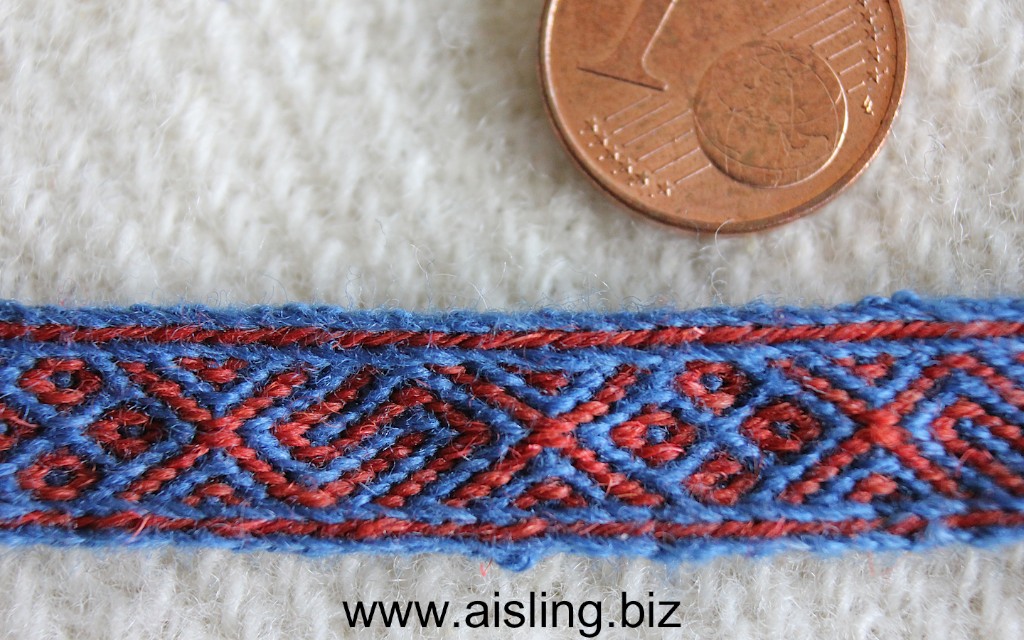
Ich liebe Bücher über das Brettchenweben, doch das Buch ist für mich bei vielen Dingen ein Beispiel, was man als Autor nicht machen darf, die man gerne hier nachlesen kann.
Nach einer Diskussion in einem Forum, wo man diese Rekonstruktion hochgelobt hat, und ich gesagt hatte, dass die Linien nicht stimmen, hatte ich keine andere Wahl und habe angefangen, dem Band sein Rätsel zu entreißen.
Genau wie E.-M. Huse habe ich mich für ein Stippengewebe entschieden und 12 Musterbrettchen gewählt.
I enjoy reading books on tablet weaving, but this one also illustrates how differently fragmentary evidence can be interpreted. You can read my detailed explanation here.
After Huse's reconstruction had been highly praised in an online forum and I commented that, in my opinion, the lines did not match those visible in the original photograph, I felt compelled to investigate the band myself.
Like Else-Margrethe Huse, I concluded that the band had been woven in pebble weave and chose to work with twelve pattern tablets.
Ungefähr 1 Woche pendelte ich zwischen Computer und Webstuhl hin und her, und jetzt denke ich, dass ich eine Version habe, die dem Original recht nahe kommt - sicher sein kann ich bei der schlechten Qualität des Bildes leider nicht.
For about a week I moved back and forth between my computer and the loom. In the end, I arrived at a version that, in my opinion, comes quite close to the original. However, given the poor quality of the surviving photograph, it is impossible to be certain.
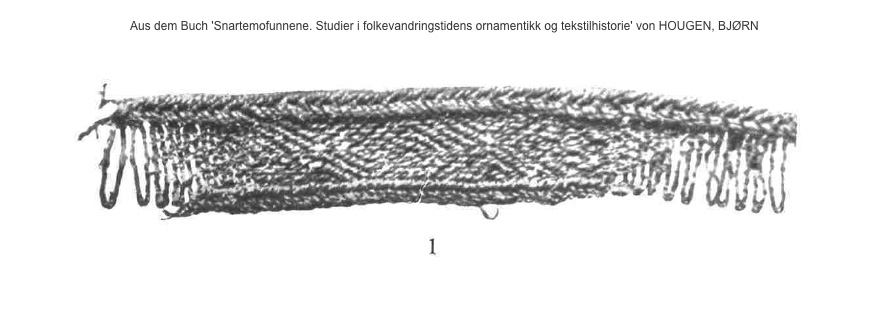
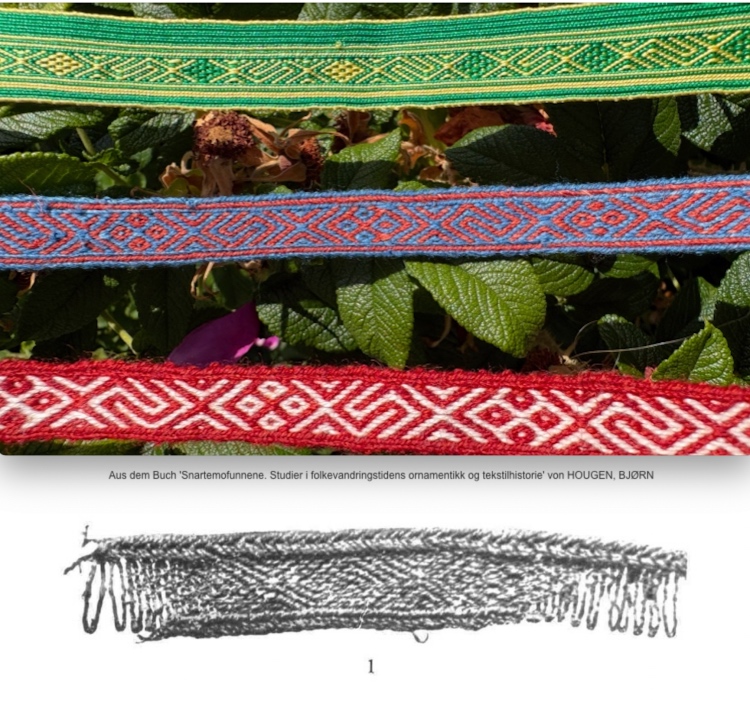
Das Bild vom Fund aus dem Buch 'Snartemofunnene. Studier i folkevandringstidens ornamentikk og tekstilhistorie' von HOUGEN, BJØRN aus dem Jahr 1935
The original photograph, published in Bjørn Hougen's Snartemofunnene. Studier i folkevandringstidens ornamentikk og tekstilhistorie (1935).
Das Muster habe ich nach jetzt der Anleitung von E.-M. Huse gewebt. Mir fehlen die 'Zickzack' Linien. Und irgendwie stimmt gar nichts...
The reconstruction based on Else-Margrethe Huse's instructions. To me, the characteristic zigzag lines are missing, which is why I cannot fully understand this reconstruction.
Eine meiner Entwürfe, wie eins der Motive im Original ausgesehen haben könnte. Es ist ein gewaltiger Unterschied zu E.-M. Huses Entwurf. Leider gab das Bild in ihrem Buch nicht genügend Details her, um das zweite Motiv zu enträtseln.
One of my interpretations of what one of the original motifs may have looked like. It differs considerably from Else-Margrethe Huse's reconstruction. Unfortunately, the photograph published in her book does not contain enough detail to decipher the second motif.
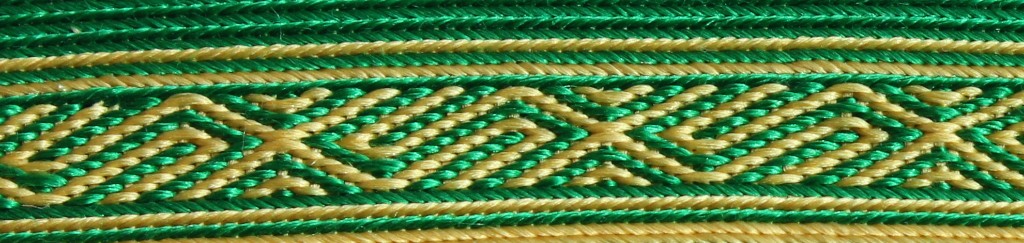
Es könnte aber auch so ausgesehen haben, das Bild vom Original ist zu ungenau, um das genau entscheiden zu können.
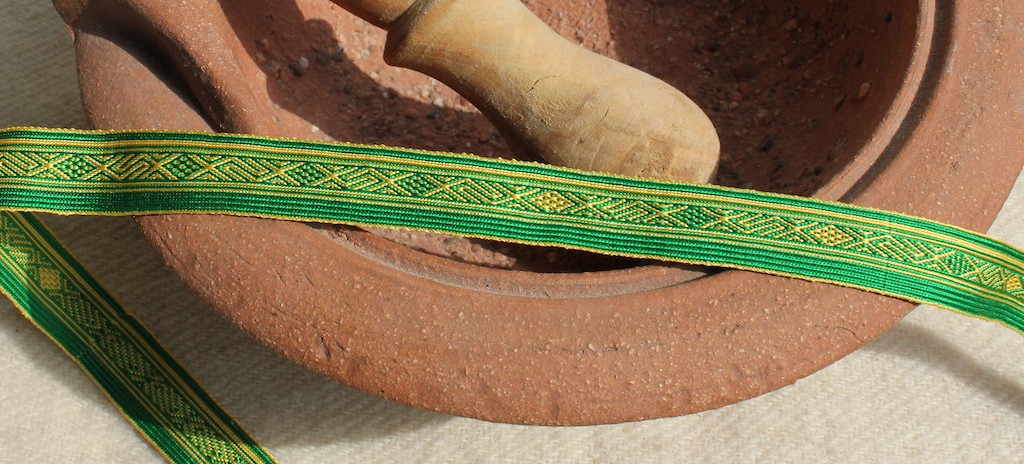
Da ich es nich so einzeln stehen lassen wollte, habe ich das Zwischenmuster frei gestaltet und das folgende Band gewebt:
Of course, the original may also have looked quite different. The surviving photograph is simply too indistinct to allow a definitive interpretation.
As I did not want to leave this motif on its own, I designed the intermediate pattern myself and wove the following band.
Mehr Informationen zu der Entstehung des Bandes gibt es in meinem Blog. Die Zusammenfassung der Diskussion und die ersten Rekonstruktionsversuche.
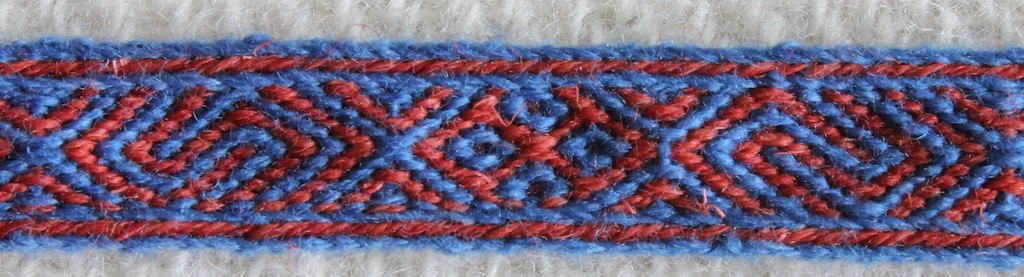
Inzwischen habe ich mehrere Bänder mit dem Muster gewebt. Einmal Mal 2014 Wolle (mit Krapp und Indigo gefärbt). Und dann 2026 in der Kombination Wolle (Krapp) und Leinengarn.
Einige kleine Veränderungen sind auch eingeflossen, da ich bei dem zweiten Motiv mehr gesehen habe und ich denke, dass ich dem Original sehr nahe gekommen bin.
Ich habe auch beim Rand ausprobiert, ob es evtl. als Rollrand gewebt worden ist, wie es behauptet wurde.
Ich sehe es nicht.
More information about the development of this band, together with a summary of the discussion and my first reconstruction attempts, can be found in my blog.
Since then, I have woven several bands using this pattern. One in 2014, using wool dyed with madder and indigo, and another in 2026 using a combination of wool dyed with madder and linen thread.
I also incorporated a few small changes after noticing more details in the second motif, and I think this version comes very close to the original.
I also experimented with the border to see whether it might have been woven as a rolled edge, as has been suggested.
I don't see it.
Literatur:
Else-Margrethe Huse, 'Reconstructed tablet woven bands from Vestfold', 2010 Bjørn Hougen, ''Snartemofunnene. Studier i folkevandringstidens ornamentikk og tekstilhistorie', 1935
Muster: Else-Margarethe Huse & eigene Entwürfe
Technik: 2-Loch-Gewebe (Stippengewebe)