
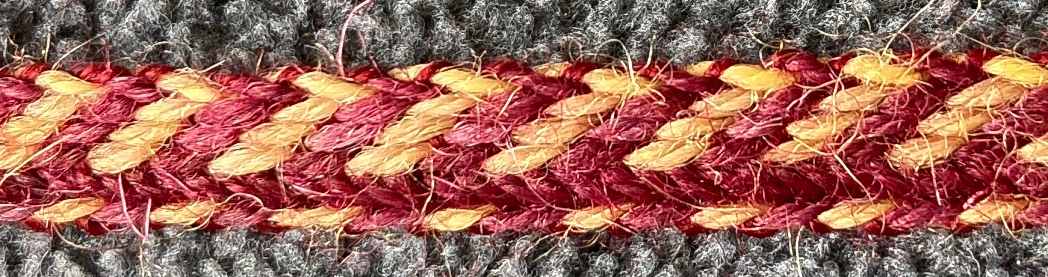
 Das Textilfragment mit der Bezeichnung R61, 3 befindet sich seit 1857 im Besitz des Landesmuseums Mainz. Es wird in den Zeitraum vom 1. Jahrhundert v. Chr. bis zum 3. Jahrhundert n. Chr. datiert.
Gefunden wurde das Textil am Schillerplatz in Mainz. Es handelt sich um ein Rautenköpergewebe mit einer angenähten Brettchenborte. Über die ursprüngliche Verwendung des Textils ist leider nichts bekannt.
The textile fragment designated R61, 3 has been in the collection of the Landesmuseum Mainz since 1857. It is dated to the period between the 1st century BC and the 3rd century AD.
The textile was found at Schillerplatz in Mainz. It is a diamond twill fabric with an attached tablet-woven band. Unfortunately, nothing is known about the textile's original use.
John-Peter Wild veröffentlichte 1982 erstmals eine Rekonstruktionszeichnung der Borte. Mit dieser Darstellung konnte ich allerdings wenig anfangen. Erst als ich 2018 die Gelegenheit hatte, die Borte im Archiv des Museums im Original zu betrachten, machte es bei mir „klick“.
Es handelt sich um ein sehr feines Band, das mit sechs Brettchen gewebt wurde. Fünf Brettchen wurden mit jeweils zwei Fäden bezogen, eines mit vier Fäden. Dieser Aufzug ist für die bisher bekannten historischen Brettchenborten ausgesprochen ungewöhnlich.
In 1982, John-Peter Wild published the first reconstruction drawing of the band. I could not make much sense of this interpretation, however. It was only when I had the opportunity to examine the original band in the museum's archive in 2018 that everything suddenly fell into place.
It is a very fine band woven with six tablets. Five tablets were threaded with two threads each, while one was threaded with four threads. This threading arrangement is highly unusual among the historical tablet-woven bands known so far.
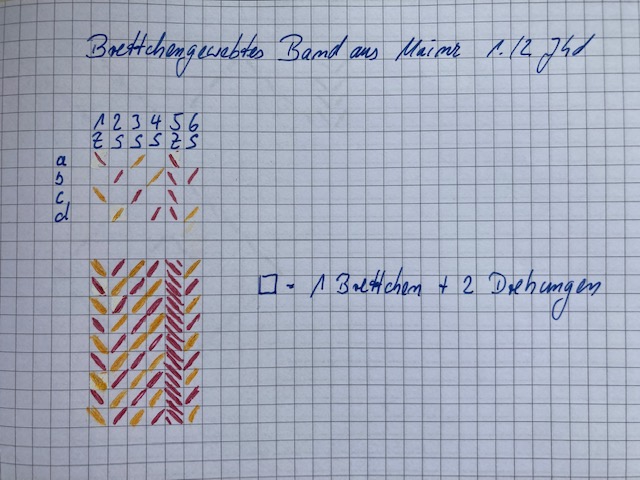
Das Muster entsteht dadurch, dass alle Brettchen kontinuierlich in dieselbe Richtung gedreht werden. Dadurch ist das Muster allerdings nicht ganz „sauber“ – auch beim Original sind nicht alle Brettchen in Z-Stellung aufgezogen. Würde man alle Brettchen gleich aufziehen, würde sich das Band beim kontinuierlichen Drehen in sich verdrehen. Durch die unterschiedliche Stellung der Brettchen bleibt die Borte dagegen flach und glatt.
The pattern is created by turning all the tablets continuously in the same direction. This does, however, mean that the pattern is not entirely “clean” – the original band also has tablets that are not all threaded in Z orientation. If all the tablets were threaded in the same direction, the band would twist in on itself as the tablets were turned continuously. By using different tablet orientations, the band remains flat and smooth.
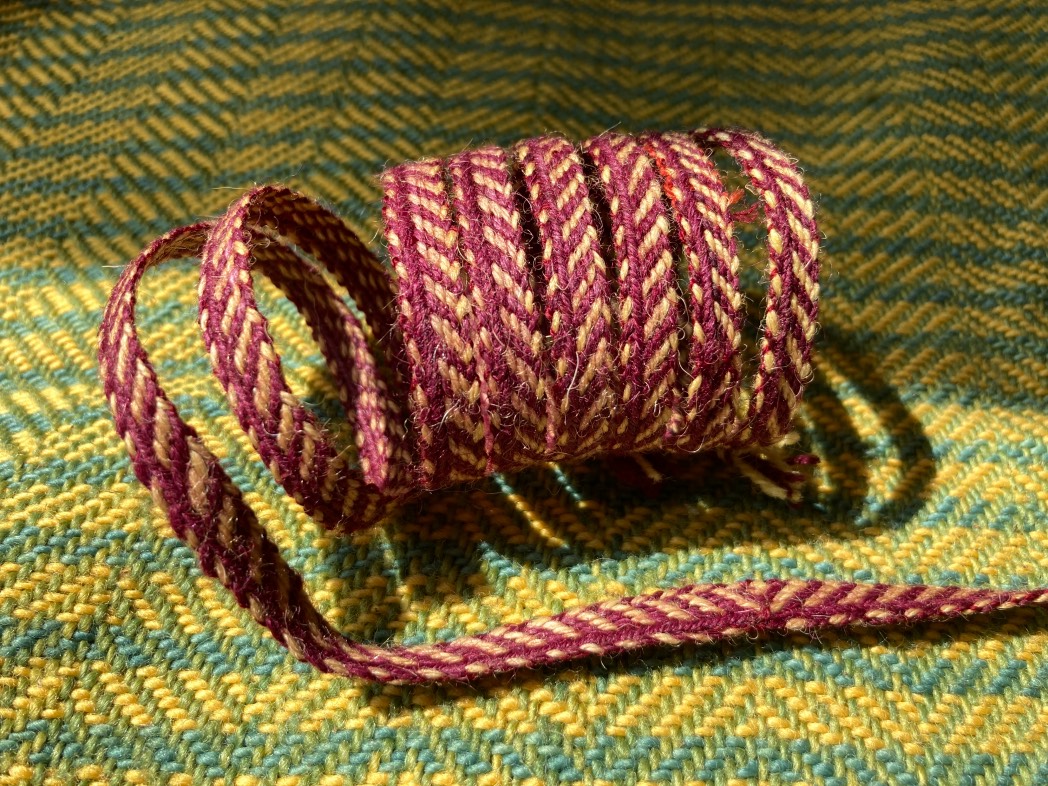
Für meine Nachwebung verwendete ich Wolle 16/2. Die fertige Borte ist etwa 0,7 bis 0,8 cm breit.
Als ich die Borte 2018 nachwebte, konnte ich das Original zwar selbst untersuchen und fotografieren, das dabei entstandene Foto darf ich jedoch nicht veröffentlichen. Inzwischen hat Sylvia Mitschke eine hervorragende Publikation zu den Textilfunden aus Mainz veröffentlicht, in der auch dieser Fund ausführlich dokumentiert und abgebildet ist.
For my reconstruction, I used 16/2 wool. The finished band is approximately 0.7–0.8 cm wide.
When I wove the band in 2018, I was able to examine and photograph the original myself. Unfortunately, I am not permitted to publish the photograph I took at the time. In the meantime, Sylvia Mitschke has published an excellent study of the textile finds from Mainz, which also documents and illustrates this particular find in detail.
Literatur:
Mitschke Sylvia, Material und Verarbeitung textiler Rohstoffe in der römischen Epoche am Beispiel der Funde aus Mainz, 2021
John Peter Wild, Some new light on Roman textiles, NESAT I, 1982
Böhme-Schönberger Astrid, Hautnah - Römische Stoffe aus Mainz, 2009
Technik: 2 Fäden pro Brettchen
Muster: eigener Entwurf