
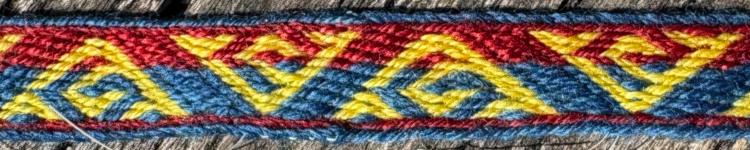
 Dieses brettchengewebte Band aus dem Salzbergwerk in Hallstatt zeigt ein Muster, das auch von der zeitgleichen Keramik bekannt ist. Im Bergwerk wurde ein Fragment dieser Borte gefunden, ihr ursprünglicher Verwendungszweck ist jedoch unbekannt.
Das Original wurde mit 13 Brettchen aus Wolle gewebt und ist etwa 0,9 cm breit.
This tablet-woven band from the Hallstatt salt mine, features a pattern also found on pottery from the same period. A fragment of this trim was found in the mine, but its original purpose is unknown.
The original was woven using 13 tabelets the material was woolen and it is approximately 0.9 cm wide.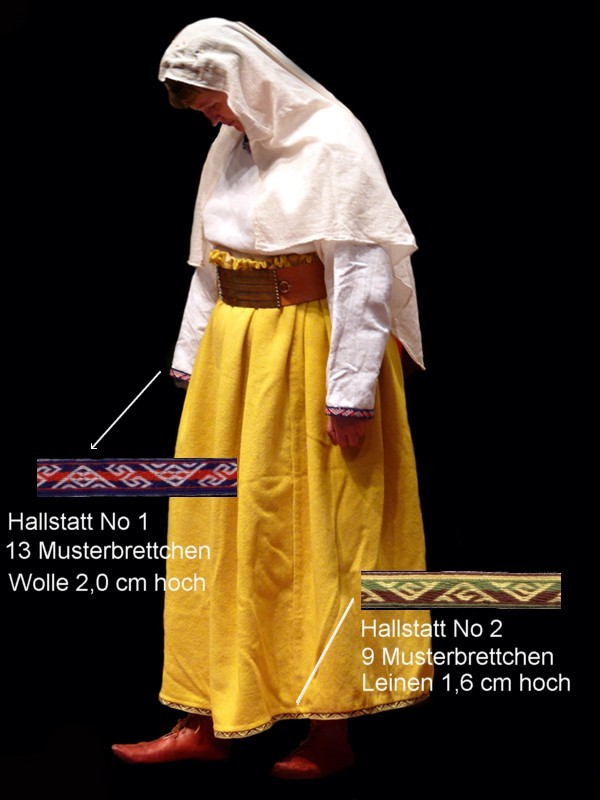
Meine erste Rekonstruktion entstand 2006/2007. Dabei orientierte ich mich an den Farben des geborgenen Fundes, verwendete jedoch Leinen anstelle von Wolle.
Die Rekonstruktion besteht aus 9 Musterbrettchen, zwei Randbrettchen auf der einen und vier Randbrettchen auf der anderen Seite. Kette und Schuss bestehen aus Leinen, die Borte ist etwa 1,6 cm breit.
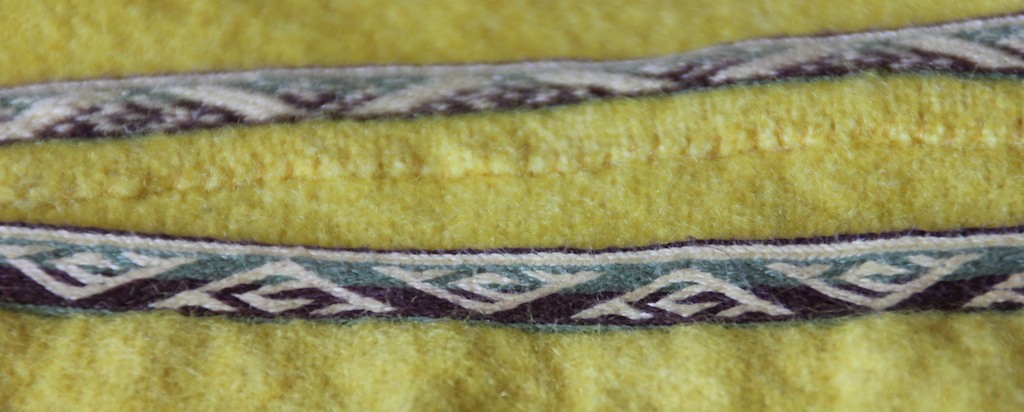
The reconstruction was woven with 9 pattern tablets, 2 border tablets at one side and 4 border tablets at the other side. Both the warp and the weft are linen, and the finished band is approximately 1.6 cm wide.
I've woven it for the first time in 2006/2007. At that time, I based the colours on the preserved textile fragment but chose to weave the band in linen instead of wool.
2016 webte ich die Borte erneut. Diesmal berücksichtigte ich den Artikel Farbstoff- und Elementanalyse an Textilien aus dem prähistorischen Salzbergwerk von Regina Hofmann-de Keijzer, Maarten R. van Bommel und Ineke Joosten. Zwar wurden die brettchengewebten Borten selbst nicht untersucht, wohl aber andere Textilien aus dem Salzbergwerk. Die Ergebnisse legen nahe, dass sich die Farben der Textilien durch das Salz und die rund 2.500-jährige Lagerung verändert haben könnten.
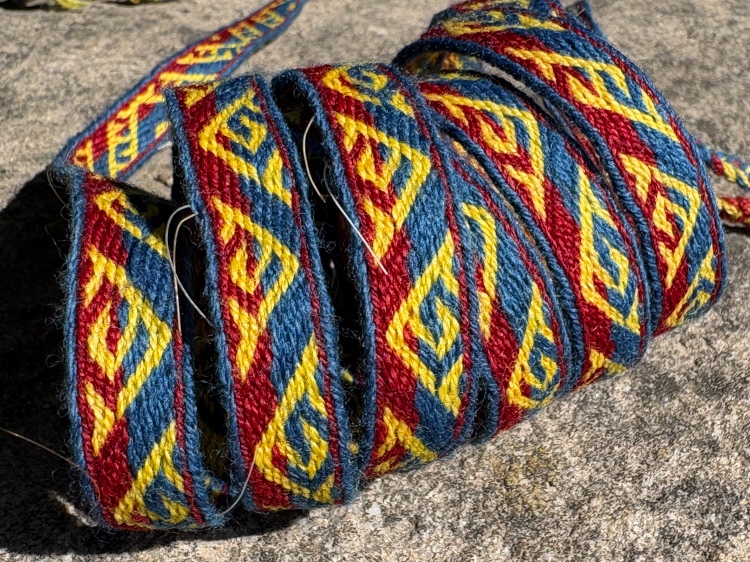
In 2016, I wove the band again. This time I took into account the article Dye and Element Analysis of Textiles from the Prehistoric Salt Mine by Regina Hofmann-de Keijzer, Maarten R. van Bommel, and Ineke Joosten. Although the tablet-woven bands themselves were not analysed, other textiles from the salt mine were. The results suggest that the colours of the textiles may have changed as a result of the salt and approximately 2,500 years of burial.
Nach längerer Überlegung erschien mir deshalb folgende ursprüngliche Farbgebung am wahrscheinlichsten:
• Blau (Waid) statt des heutigen Dunkelgrüns
• Rot (Kermes) statt Dunkelbraun
• Gelb (Reseda) statt des bräunlichen Gelbs
Da mir weder Waid noch Kermes zur Verfügung standen, verwendete ich Indigo als Ersatz für Waid und Krapp anstelle von Kermes.
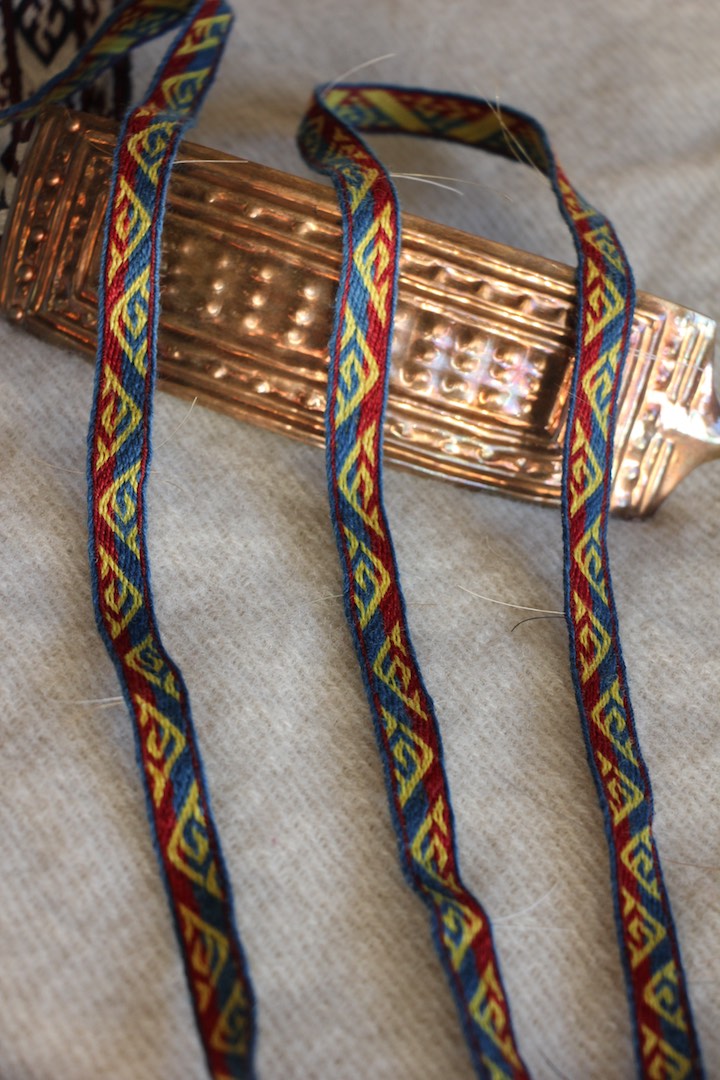
After careful consideration, I concluded that the original colours were most likely:
• Blue (woad) instead of the present dark green
• Red (kermes) instead of dark brown
• Yellow (weld) instead of the present brownish yellow
As I did not have woad or kermes available, I used indigo as a substitute for woad and madder instead of kermes.
Gewebt wurde die Rekonstruktion mit 20/2-Wolle. Als Schussfaden verwendete ich Pferdehaar (Schweifhaar), das lediglich gewaschen, aber nicht weiter verarbeitet wurde. Mit einer Breite von 1,0 cm liegt diese Rekonstruktion deutlich näher am historischen Original.
Literatur:
GRÖMER, K., "Brettchenwebereien aus dem Salzbergwerk in Hallstatt", Archäologie Österreichs, vol. 12, Wien, Österreichische Gesellschaft für Ur- und Frühgeschichte, pp. 49-58, 2001.
Hallstatt Textiles - Technical Analysis, Scientific Investigation and Experiment on Iron Age Textiles, 2005
Technik: Köperbindung
Muster: Eigener Entwurf