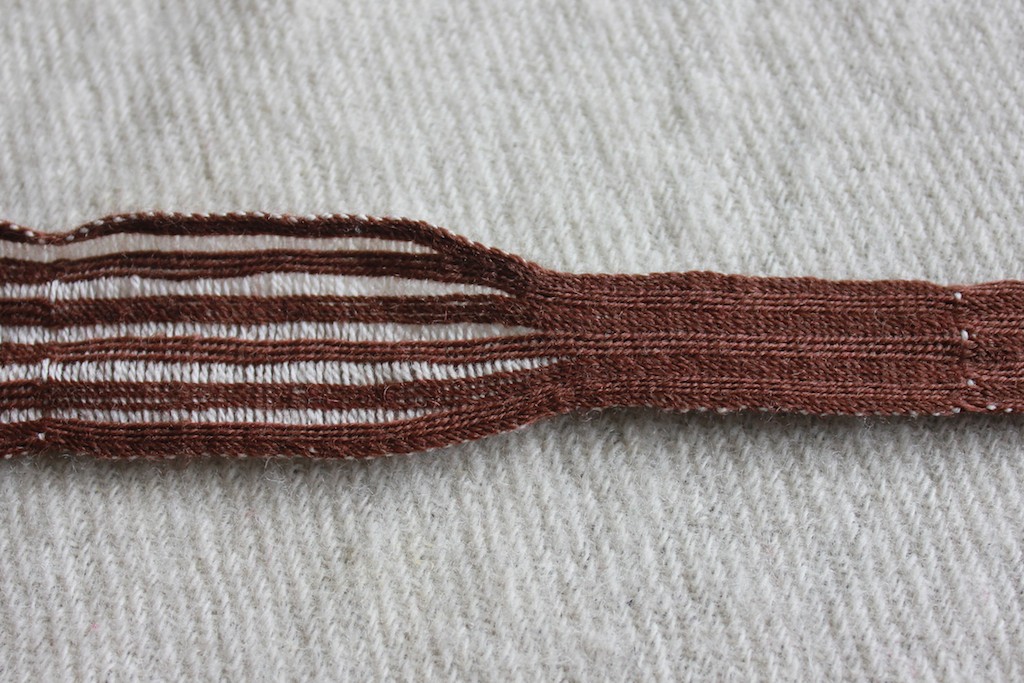
 Es handelt sich um ein einfaches brettchengewebtes Band, dessen besonderer Blickfang der kontrastfarbene Schussfaden ist, der im breiteren Bereich der Borte sichtbar wird.
Für meine Nachwebung habe ich ein Muster aus Textilfunde der Eisenzeit von Karl Schlabow verwendet.
This is a simple tablet-woven band whose most striking feature is the contrasting weft thread, which becomes visible in the wider sections of the band.
For my reconstruction, I used a pattern published by Karl Schlabow in Textilfunde der Eisenzeit.
Im Gegensatz zu Schlabows Beschreibung habe ich die 20 Brettchen nicht in der Folge 4–3–3–3–3–4, sondern – anhand der Abbildung des Originalfundes – in der Folge 5–3–3–3–3–3 aufgeteilt. Ob diese Aufteilung tatsächlich richtig ist, kann ich nicht beurteilen. Schlabow hatte das vollständige Band zur Untersuchung vorliegen, ich dagegen nur eine Abbildung eines kleinen Ausschnitts. Deshalb habe ich mich bewusst an dem orientiert, was ich auf dem Foto erkennen konnte.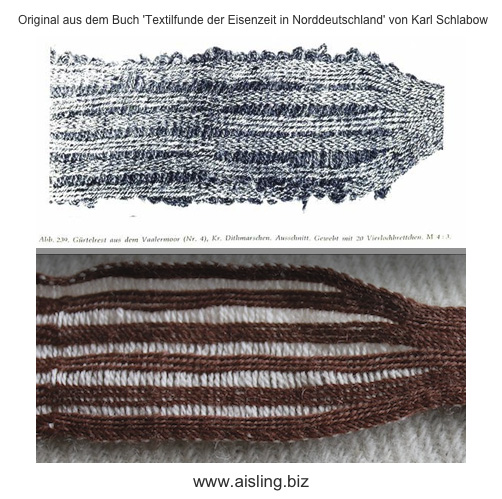
Unlike Schlabow's description, I did not arrange the 20 tablets in the sequence 4–3–3–3–3–4. Instead, after studying the photograph of the original band, I chose the sequence 5–3–3–3–3–3. Whether this arrangement is actually correct, I cannot say. Schlabow had the complete band available for examination, whereas I had only a photograph of a small section. I therefore chose to weave what I could actually see in the surviving image.
Vergleich zwischen Original und Nachwebung
Die Datierung des Bandes ist schwierig. Richard Stettiner ordnete die Funde aus Damendorf, Daetgen und Thorsberg bereits 1911 anhand der zugehörigen Metallfunde in das 4. Jahrhundert ein. Auf dieser Einschätzung beruhen auch die späteren Datierungen.
Comparison of the original and my reconstruction
Dating this band is not straightforward. In 1911, Richard Stettiner assigned the finds from Damendorf, Daetgen and Thorsberg to the 4th century on the basis of the associated metal finds. All later datings are based on this assessment.
Die Textilien aus dem Vaalermoor wurden jedoch ohne eindeutig datierbare Beifunde entdeckt. Deshalb lässt sich lediglich sagen, dass sie vermutlich irgendwann zwischen dem 2. und 4. Jahrhundert n. Chr. hergestellt wurden.
Unfortunately, the textiles from Vaalermoor were found without any securely datable associated finds. It can therefore only be said that they were probably woven sometime between the 2nd and 4th centuries AD.
Das Original wurde mit 20 Brettchen gewebt. Als Kettmaterial diente naturweiße Wolle, der Schuss bestand aus naturbrauner Wolle. Nach Schlabow betrug der Aufzug 4S, 3Z, 3S, 3Z, 3S und 4Z. Je nach Musterbereich ist die Borte etwa 2 cm beziehungsweise 4,5 cm breit.
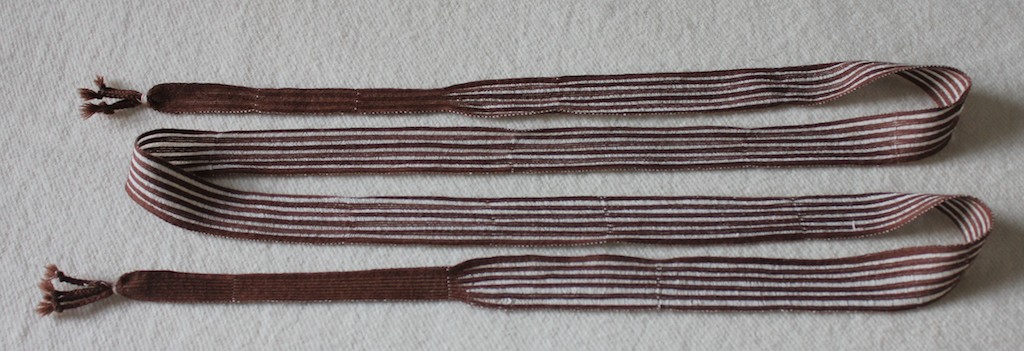
Für meine Nachwebung verwendete ich ebenfalls 20 Brettchen. Die Kette besteht aus naturbrauner Wolle, der Schuss aus naturweißer Wolle. Der Aufzug lautet 3S, 3Z, 3S, 3Z, 3S und 5Z. Je nach Musterbereich ist die Borte etwa 1,8 cm beziehungsweise 3,5 cm breit. Damit bleibt sie insgesamt schmaler als das Original – eines der wenigen Bänder, bei denen ich mit zu feinem Material gearbeitet habe.
The original band was woven with 20 tablets. The warp consists of natural white wool, while the weft is natural brown wool. According to Schlabow, the threading sequence is 4S, 3Z, 3S, 3Z, 3S and 4Z. Depending on the pattern section, the band is approximately 2 cm or 4.5 cm wide.
For my reconstruction, I also used 20 tablets. The warp is natural brown wool, the weft natural white wool, and the threading sequence is 3S, 3Z, 3S, 3Z, 3S and 5Z. Depending on the pattern section, my reconstruction is approximately 1.8 cm or 3.5 cm wide. It is therefore narrower than the original—one of the very few bands for which I chose a yarn that turned out to be too fine.
Literatur:
Möller-Wiering, S.: War and Worship, 2011, S. 41
Schlabox Karl: Textilfunde der Eisenzeit in Norddeutschland, Neumünster, 1976
Stettiner Richard, Brettchenweberein in den Moorfunden von Damendorf, Daetgen und Torsberg, Hamburg, 1911
Anleitung: Karl Schlabow
Technik: Schnurbindung