
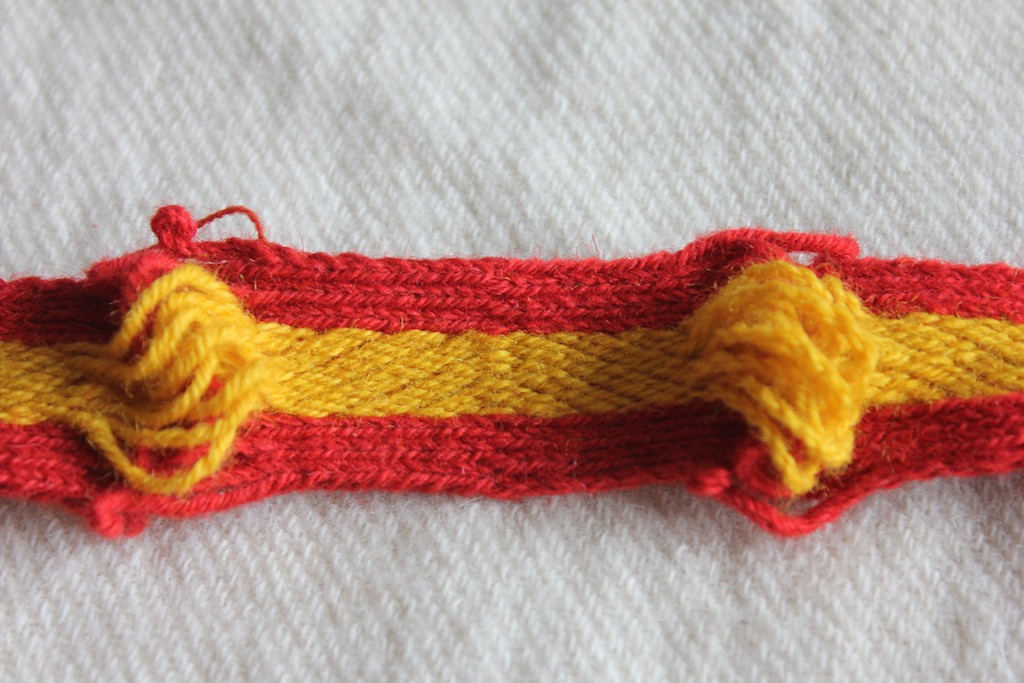
 Die Funde aus dem Vaalermoor wurden laut Karl Schlabow um 1880 bei der Gewinnung von Torf zum Heizen aus dem Moor geborgen. Viele Jahre lagerten sie in einer Kiste, bevor sie 1943 dem Textilmuseum Neumünster übergeben wurden. 1954 wurden die Textilien erstmals im Labor untersucht.
Insgesamt vier dieser Fragmente enthielten brettchengewebte Bestandteile. Dieses Band ist eines davon.
According to Karl Schlabow, the finds from the Vaalermoor were recovered from the bog around 1880 during the extraction of peat for fuel. They were stored in a box for many years before being transferred to the Textile Museum Neumünster in 1943. The textiles were first examined in the laboratory in 1954.
A total of four of these fragments contained tablet-woven elements. This band is one of them.
Das Band wurde aus Wolle mit 24 Brettchen gewebt. Davon waren jeweils sechs Randbrettchen mit vier Fäden und zwölf Musterbrettchen mit jeweils zwei Fäden bezogen. Das Band ist etwa 3 cm breit.
Die Kette besteht aus zwei Fäden, von denen einer von links und der andere von rechts eingelegt wurde.
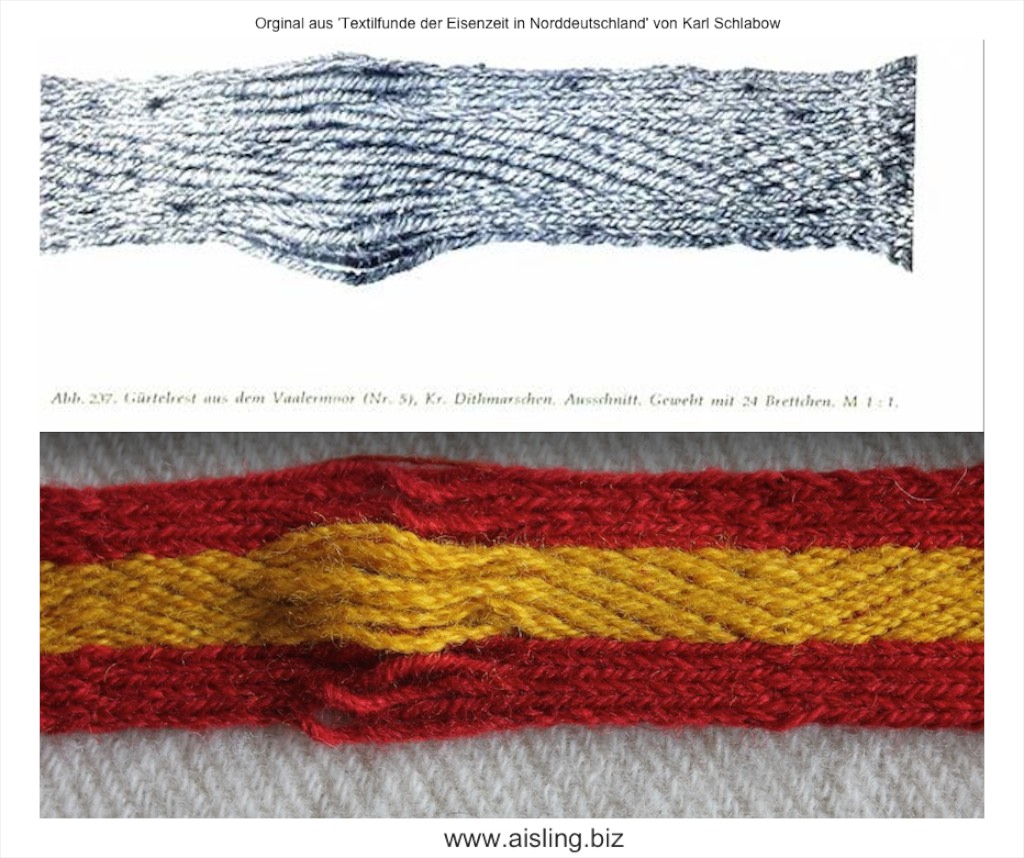
The band was woven from wool using 24 tablets. Six border tablets on each side were threaded with four threads each, while the twelve pattern tablets were threaded with two threads each. The band is approximately 3 cm wide.
The warp consists of two threads, one inserted from the left and the other from the right.
Für meine Nachwebung habe ich folgendermaßen gearbeitet: Zunächst werden etwa 3 cm gewebt, indem alle Brettchen in dieselbe Richtung gedreht werden. Anschließend werden die Brettchen über weitere 3 cm in die entgegengesetzte Richtung gedreht. Danach werden die Schussfäden verknotet und die Brettchen etwa 4 cm weitergedreht, ohne einen Schussfaden einzulegen.
Anschließend wird wieder mit Schussfaden gewebt.
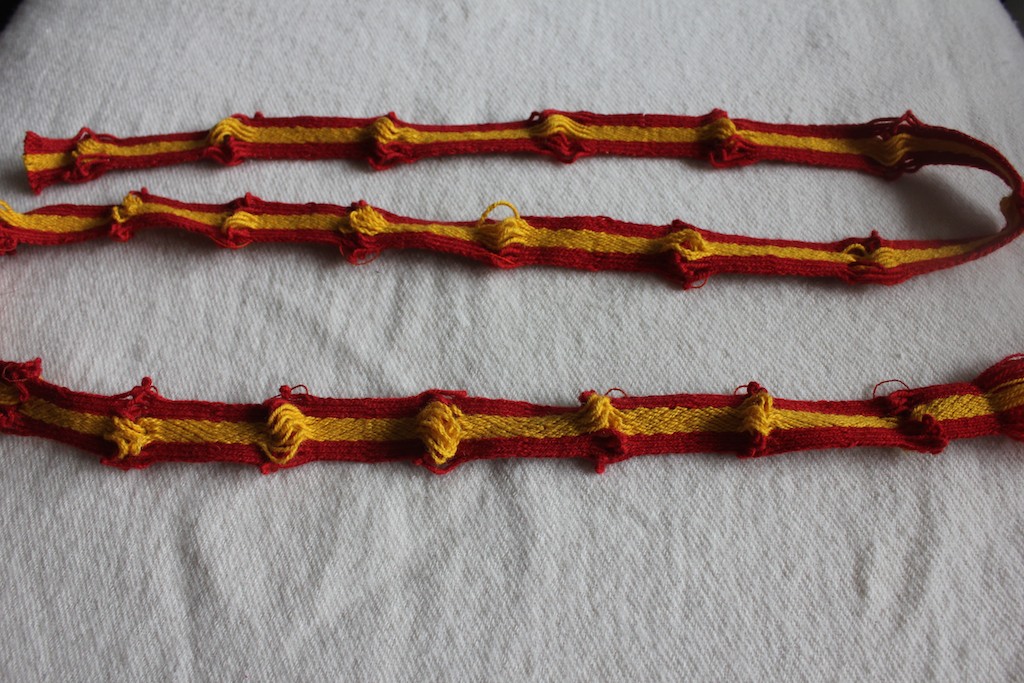
For my weaving, I worked as follows: First, approximately 3 cm are woven by turning all the tablets in the same direction. The tablets are then turned in the opposite direction for another 3 cm. The weft threads are then knotted, and the tablets are turned for approximately 4 cm without inserting a weft thread.
After that, weaving continues with the weft thread.
Literatur:
Möller-Wiering, S.: War and Worship, 2011, S. 41
Schlabow Karl: Textilfunde der Eisenzeit in Norddeutschland, Neumünster, 1976
Stettiner Richard: Brettchenweberei in den Moorfunden von Damendorf, Daetgen und Torsberg, Hamburg, 1911
Anleitung: Karl Schlabow
Technik: Schnurbindung/Stippengewebe