
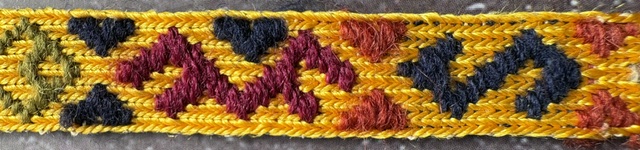
 Dieses brettchengewebte Band stammt aus einem Grab des 10. Jahrhunderts in Køstrup auf der dänischen Insel Fünen.
In den Jahren 1980 und 1981 wurde dort ein Gräberfeld archäologisch untersucht. Von den fünfzehn freigelegten Bestattungen enthielt lediglich Grab ACQ bemerkenswerte Textilfunde. Darunter befand sich ein 13,3 cm langes und 1,4 cm breites Fragment eines brettchengewebten Bandes.
This tablet-woven band originates from a 10th-century grave at Køstrup on the Danish island of Funen.
In 1980 and 1981, an archaeological excavation was carried out at the cemetery. Of the fifteen excavated graves, only grave ACQ contained remarkable textile finds. Among them was a 13.3 cm long and 1.4 cm wide fragment of a tablet-woven band.
Erhalten blieben von der Kette je zwei blaue Wollfäden pro Brettchen. Der Schussfaden war nicht mehr vorhanden, weshalb angenommen wird, dass er aus Leinen bestand. Das Band ist mit mehrfarbigen Mustern in Broschiertechnik gewebt und wird als Besatz der Frauenkleidung interpretiert, vermutlich zwischen den Fibeln getragen.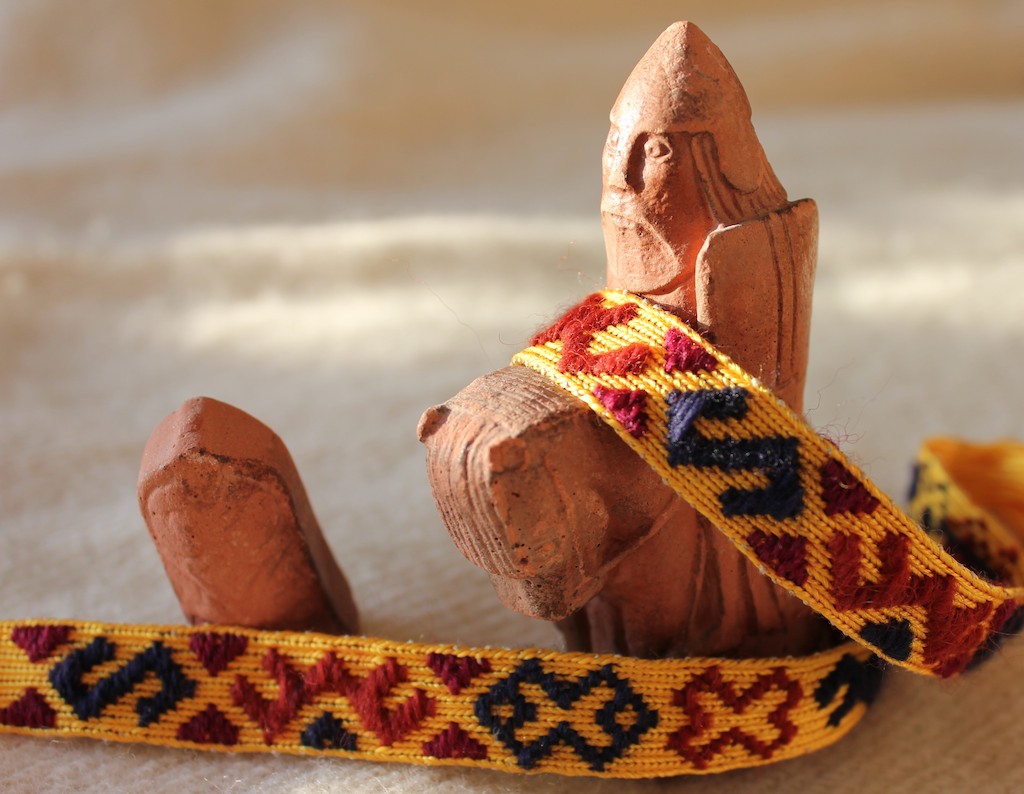
Two blue wool warp threads survived in each tablet hole. The weft has not survived, suggesting that it was made of linen. The band was woven with multicoloured patterns in the brocading technique and is thought to have served as a decorative trim on women's clothing, probably worn between the oval brooches.
Nach der Untersuchung von Lise Ræder Knudsen wurde das Band mit 17 Brettchen gewebt. Jedes Brettchen war mit zwei Wollfäden und zwei Fäden aus einem anderen Material – wahrscheinlich Leinen – bezogen. Das Grundgewebe wurde in Köpertechnik gearbeitet und anschließend broschiert.
According to the analysis by Lise Ræder Knudsen, the band was woven with 17 tablets. Each tablet was threaded with two wool threads and two threads of another material, most likely linen. The ground weave was worked in the 3/1 broken twill technique and subsequently brocaded.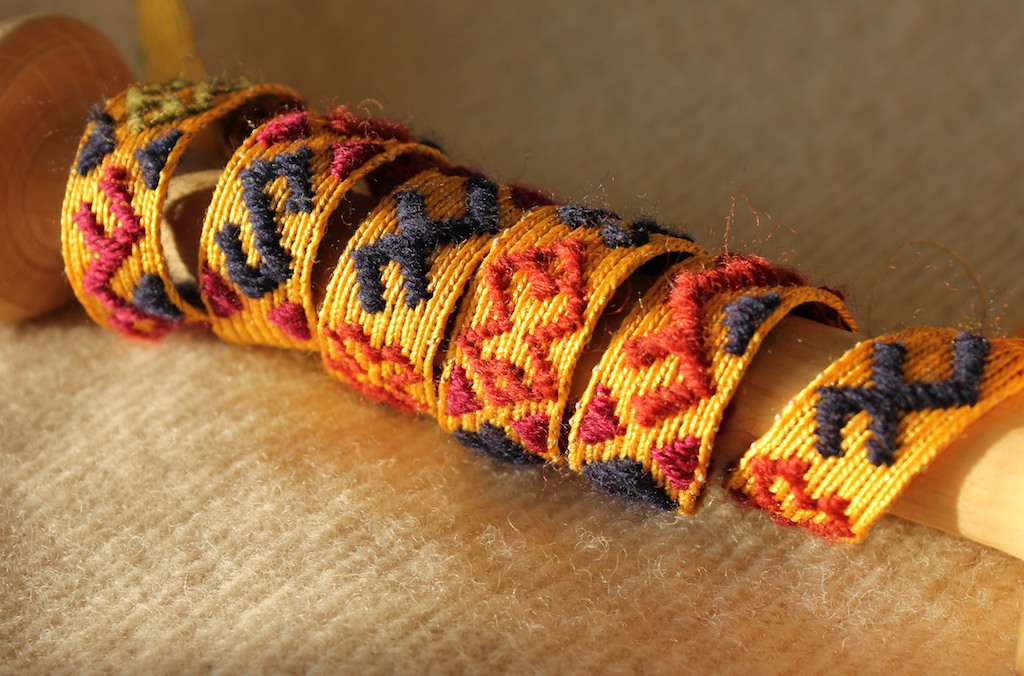
Eigentlich hatte ich nicht vor, dieses Band zu rekonstruieren. Da auf einem bereits geschärten schmalen Band noch etwas Platz war, nutzte ich die Gelegenheit, um die Broschierung auf einem einfarbigen Grundgewebe auszuprobieren. Inzwischen bin ich jedoch überzeugt, dass meine Umsetzung der Broschierung nicht vollständig der historischen Vorlage entspricht, sondern es eher eine Kombination aus Broschierung und Soumak-Technik ist, wie es auch schon vorgestellt wurde. Irgendwann werde ich es neu weben.
Originally, I had no intention of reconstructing this band. However, I still had some space left on a narrow warp that was already set up, so I took the opportunity to experiment with the brocading on a plain ground weave. I am now convinced that my reconstruction of the brocading does not fully correspond to the original. Instead, it appears to be more of a combination of brocading and the Soumak technique, as has also been suggested by other researchers. At some point, I intend to weave a new reconstruction.
Daten der Rekonstruktion
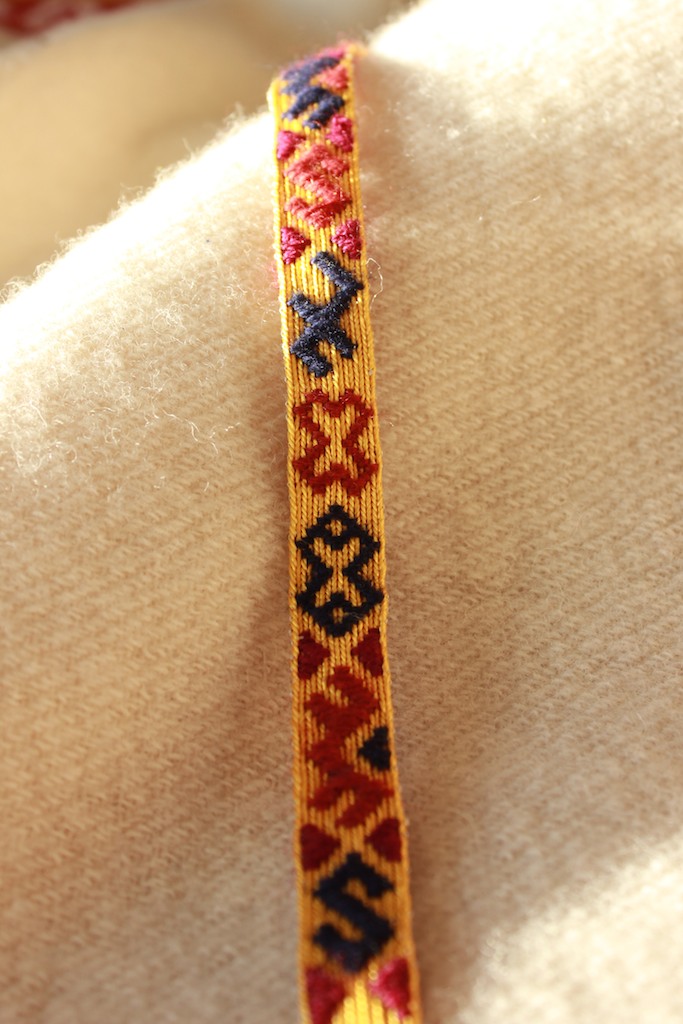
Für meine Rekonstruktion verwendete ich 15 Brettchen. Die fertige Borte ist etwa 1,4–1,5 cm breit. Die Kette besteht aus gelber Seide (Nm 11), der Schuss aus Leinengarn. Für die Broschierung kam selbstgesponnene und selbstgezwirnte Wolle zum Einsatz.
Reconstruction data
My reconstruction was woven with 15 tablets. The finished band measures approximately 1.4–1.5 cm in width. The warp consists of yellow silk (Nm 11), while the weft is linen. The brocading was worked with hand-spun and hand-plied wool.
Literatur:
The aprondress from Køstrup (grave ACQ) Website stand September 2013
Musterentwurf: Eigner Entwurf basierend auf die o.g. Website
Technik: Broschierung