
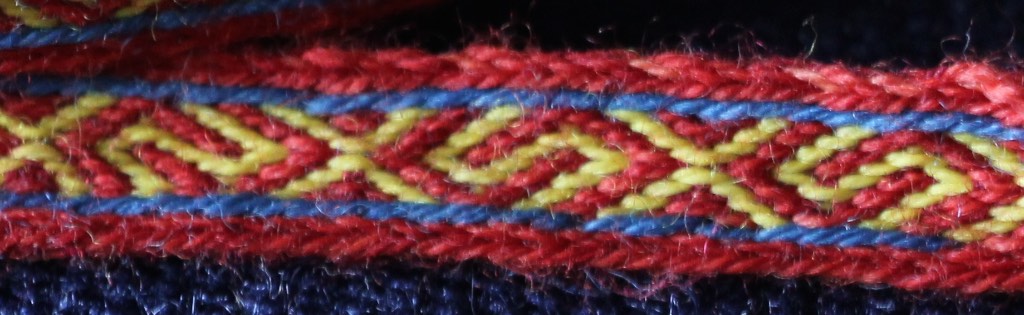
 Ein brettchengewebtes Band aus dem Gräberfeld Ladoga / Russland.
Der Ort Lagoda wurde um 750 n.Chr. aus dem skandinavischen Raum besiedelt und liegt etwa 15 Kilometer südlich der Mündung des Wolchow in den Ladogasee, nicht ganz 150 km östlich von St. Petersburg.
Die Funde aus dem Gräberfeld stammen aus einer späteren Zeit und werden auf das 10. bis 12. Jahrhundert geschätzt.
The village Lagoda has been built around the year 750. The settelment has Scandinavian origin. The town is located in the south of the mouth of the Wolchow in the Lake Ladoga, not yet 150 km east of St. Petersburg.
The finds of the burial ground are dated later and are of the 10th to the 12th century.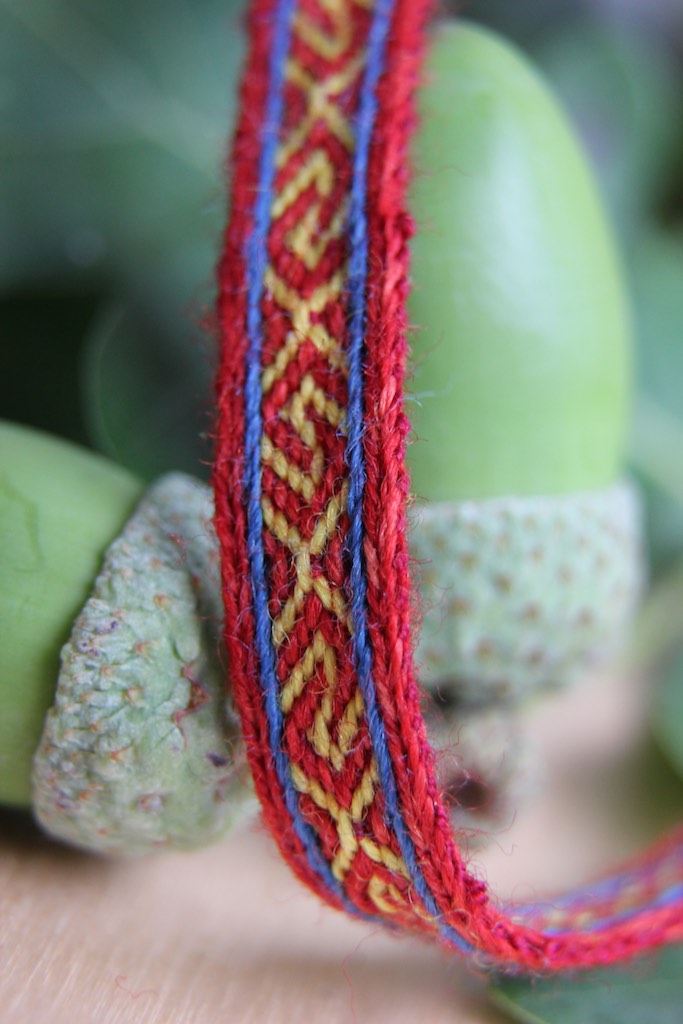
Leider gibt es die Veröffentlichung der Fundberichte nur auf Russisch (die Sprache beherrsche ich nicht), so dass ich bei der Übersetzung der Texte auf ein Dolmetscher-Programm angewiesen war. Da die Übersetzung von Fachbegriffen bestenfalls ‚schwierig‘ ist, habe ich mich auf das konzentriert, was für mich am aussagekräftigsten war: Das Bild von dem Band und die Skizze.
Doch da ist mir bei näherer Betrachtung ein großer Unterschied aufgefallen: Das Detailbild von der Original-Borte ist für mich ein Zweilochgewebe (2 Fäden pro Brettchen) während es in dem Buch als Vierlochgewebe gezeichnet und nachgearbeitet wurde. Aber wenn man das Original mit der Rekonstruktion aus dem Buch vergleicht, stellt man fest, dass das Muster zwar passt, aber die Struktur nicht.
As I don’t speak Russian – the language of the publication of the finds - I needed the help of a translation software. But the translation of the textile terms has been difficult so I fell back to the things I could understand: the picture of the band, the drawing and the woven reconstruction. But comparing these three I found a big difference: the pattern fits but the original weaving seems to be done only with two threads per tablet but the drawing and the reconstruction have been done as 3/1 broken twill.
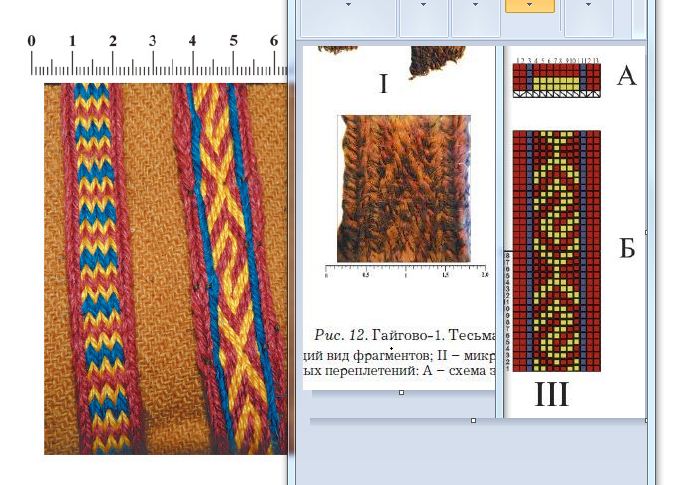
Aus der Veröffentlichung: links - Rekonstruktion, mitte - Original, rechts - Zeichnung
Im direkten Vergleich sieht man, dass die Struktur nicht passt und bei der Rekonstruktion sind neben dem gelben X noch weitere
gelbe Punkte, die es weder im Original, noch in der Zeichnung gibt.
left - the reconstruction, middle - the original, right the drawing
Comparing it directly you see that there is a big difference in structur and the yellow dots in the
new weaving are neither in the original nor in the drawing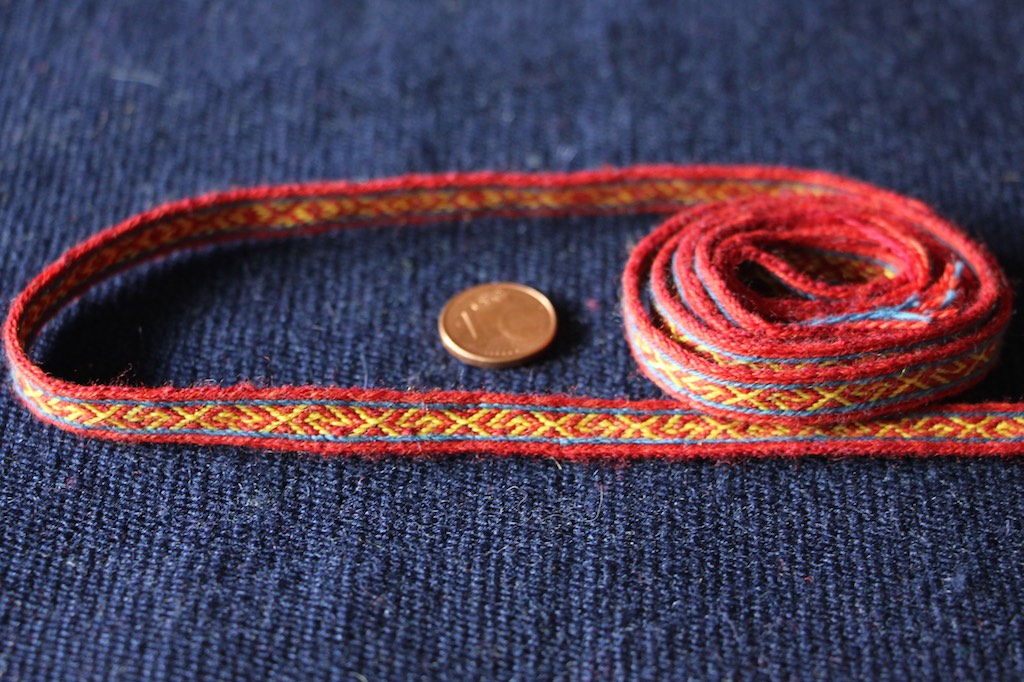
Das Original wurde mit 13 Brettchen gewebt. Allerdings bin ich mir nicht sicher, ob die Fäden tatsächlich ausgezählt wurden, da in der Übersetzung die Angabe „total required 52 threads“ auftaucht. Bei einer Ausführung in Zweilochtechnik müssten es jedoch insgesamt 34 Fäden sein: An jeder Seite befinden sich drei Randbrettchen mit jeweils vier Fäden, dazwischen sieben Musterbrettchen mit jeweils zwei Fäden. Die Originalbreite wird mit 1,6–1,8 cm angegeben. Die Randbereiche sind rot und blau, das Muster ist rot und gelb.
Für meine Rekonstruktion verwendete ich naturgefärbte Wolle 20/2. Beim Aufziehen und anschließenden Weben erlebte ich dabei allerdings eine Überraschung. Normalerweise entspricht dieses Garn in meinen Rekonstruktionen recht gut den historischen Abmessungen oder ist sogar etwas zu dick. Bei dieser Borte ist es jedoch deutlich zu dünn. Statt der beim Original angegebenen Breite von 1,6–1,8 cm erreichte meine Rekonstruktion lediglich eine Breite von etwa 0,7–0,8 cm.
Das deutet darauf hin, dass für diese Borten ein sehr einfaches und relativ grobes Garn verwendet wurde. Zusammen mit den vergleichsweise einfachen Borten lässt dies vermuten, dass die im Grab bestattete Person keiner besonders wohlhabenden Schicht angehörte. Einen deutlichen Kontrast dazu bilden die auf demselben Gräberfeld gefundenen aufwändig broschierten Borten. Bei diesen wurden teilweise bis zu 60 Brettchen benötigt, um eine Breite von lediglich etwa 2 cm zu erreichen.
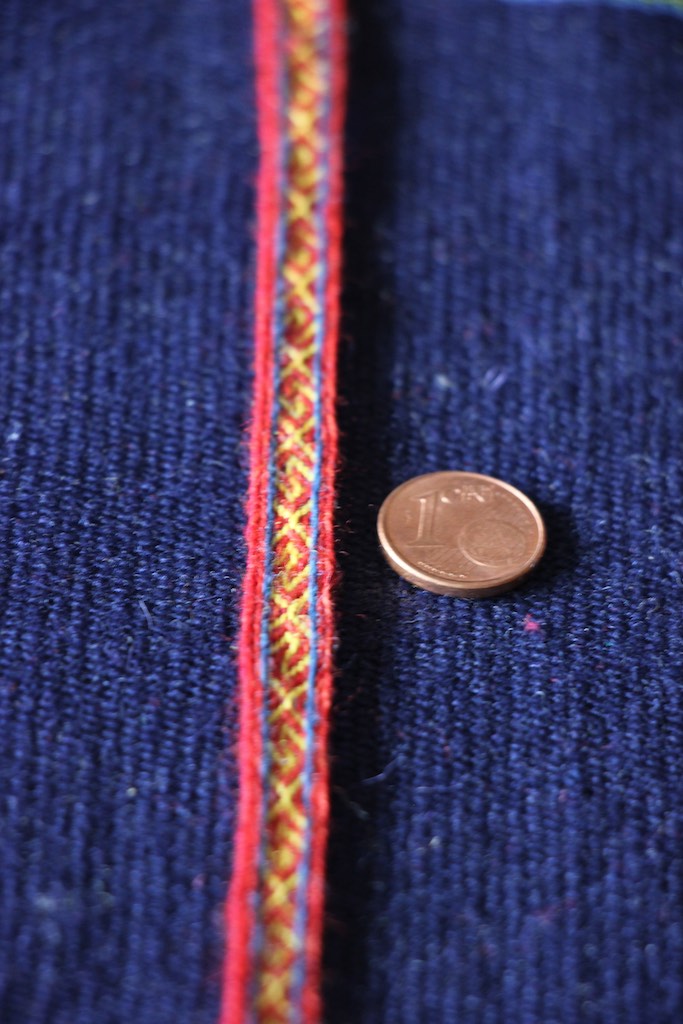
The original band was woven with 13 tablets. However, I am not certain that the threads were actually counted, as the translated description gives the figure “total required 52 threads.” In the two-hole technique, however, there should be a total of 34 threads: three border tablets with four threads each on either side, and seven pattern tablets with two threads each in between. The original band is reported to be 1.6–1.8 cm wide. The borders are red and blue, while the pattern is red and yellow.
For my reconstruction, I used naturally dyed 20/2 wool. However, I encountered a surprise while setting up the warp and weaving the band. Usually, this yarn corresponds quite well to the dimensions of the historical originals in my reconstructions, or is even slightly too thick. In this case, however, it turned out to be much too fine. Instead of the original width of 1.6–1.8 cm, my reconstruction is only about 0.7–0.8 cm wide.
This suggests that these bands were woven with a very simple, relatively coarse yarn. Together with the comparatively simple design of the bands, this may indicate that the person buried in the grave did not belong to a particularly wealthy social class. This contrasts markedly with the more elaborate brocaded bands found in the same cemetery. Some of these required as many as 60 tablets to achieve a width of only about 2 cm.
Literatur: С. И. КОЧКУРКИНА, О. В. ОРФИНСКАЯ. ПРИЛАДОЖСКАЯ КУРГАННАЯ КУЛЬТУРА: ТЕХНОЛОГИЧЕСКОЕ ИССЛЕДОВАНИЕ ТЕКСТИЛЯ.by ольга орфинская Online zu finden bei academia.edu
Anleitung: eigener Entwurf
Technik: zwei Fäden pro Brettchen (wird auch Stippengwebe genannt)