
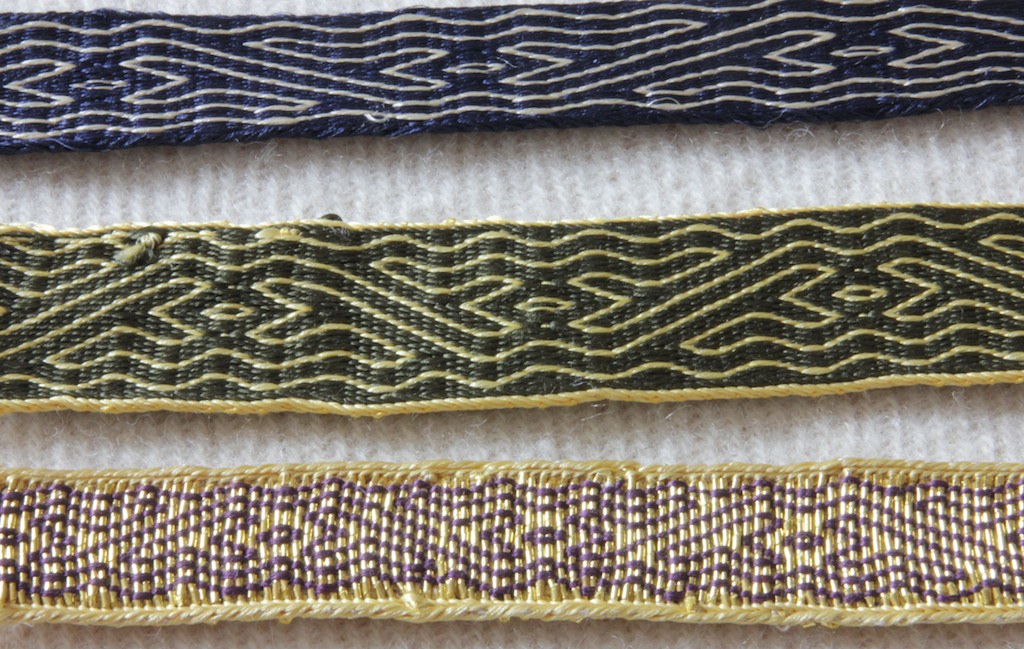
 Die Altartuchborte gehört zu einem Altartuch mit der Inventarnummer DS158, das wahrscheinlich aus Niedersachsen stammt und in die Mitte bis zweite Hälfte des 14. Jahrhunderts datiert wird.
Das etwa 320 × 150 cm große Altartuch besteht aus 18 zusammengesetzten Stickereifeldern, die von einem 4,5 cm breiten Rahmen mit blauem Grund eingefasst werden. Zur Verbindung der einzelnen Felder wurden rund 22 Meter Brettchenborte aufgenäht, die aus unterschiedlichen Borten besteht.
The altar cloth bands belong to an altar cloth with the inventory number DS158, which probably originates from Lower Saxony and is dated to the mid- to late 14th century.
he altar cloth, measuring approximately 320 × 150 cm, consists of 18 joined embroidered panels, framed by a 4.5 cm wide frame with a blue background. To join the individual panels, around 22 metres of narrow braid, comprising various types of bands, was sewn on.
Die hier gezeigte Rekonstruktion zeigt eines der sechs rund 1,5 Meter langen Bortenstücke. Die sechs Bortenstücke zeigen unterschiedliche, sich jeweils über die gesamte Länge wiederholende Motive.
Die Kette der Originalborte besteht aus roter Seide und weißem Leinengarn, der Schuss aus Leinen. Broschiert wurde mit Goldlahn, genauer mit vergoldetem Silberlahn, das um eine rote Seidenseele gewickelt wurde. 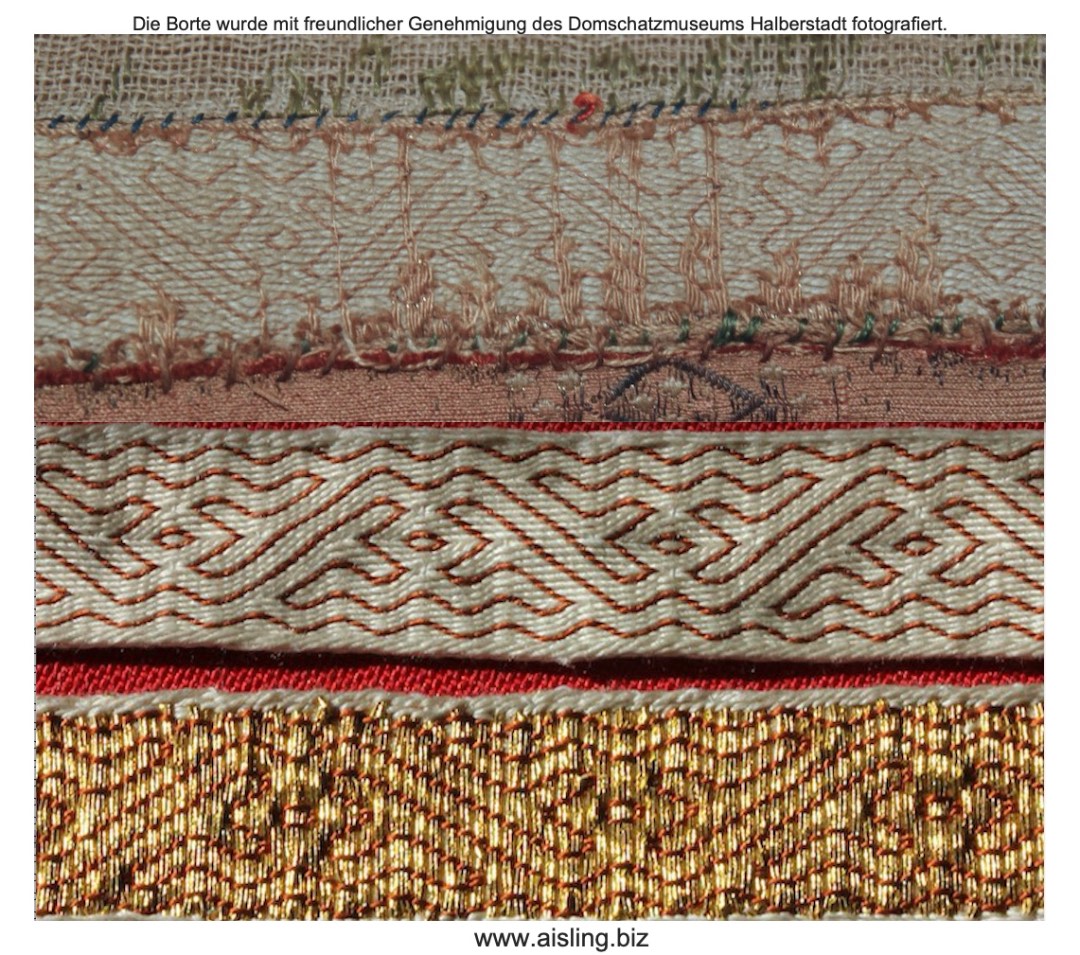
The altar cloth, measuring approximately 320 × 150 cm, consists of 18 joined embroidered panels, framed by a 4.5 cm wide frame with a blue background. To join the individual panels, around 22 metres of narrow braid, comprising various types of bands, was sewn on.
The reconstruction presented here shows one of the six pieces of braid, each approximately 1.5 metres long. The six pieces of braid feature different motifs, each of which is repeated along their entire length.
The warp of the original braid consists of red silk and white linen yarn, whilst the weft is made of linen. The embroidery was done with gold thread – more precisely, gilded silver thread – wound around a red silk core.
An einer Stelle ist die Originalborte durch den jahrhundertelangen Gebrauch so stark abgenutzt, dass von der Broschierung kaum noch etwas erhalten ist und lediglich das Grundgewebe sichtbar bleibt.
Das Muster der hier gezeigten Rekonstruktion wurde vor vielen Jahren von Fabian Peise entworfen. Nachdem ich 2014 Gelegenheit hatte, das Original im Museum zu betrachten, halte ich seine Rekonstruktion für stimmig.
Für diese Nachwebung wurde die Kette mit zwei Farben aufgekettet – drei helle und ein dunkler Faden pro Brettchen. Das Muster ist ein Einzugsmuster mit individuellem, festem Drehrhythmus.
Als ich die Borte 2015 nachwebte, lag die Materialanalyse noch nicht vor. Deshalb verwendete ich NM-11-Seide für die Kette und broschierte mit Goldlahn. Mit einer Breite von 2,6 cm kommt die Rekonstruktion dem Original sehr nahe.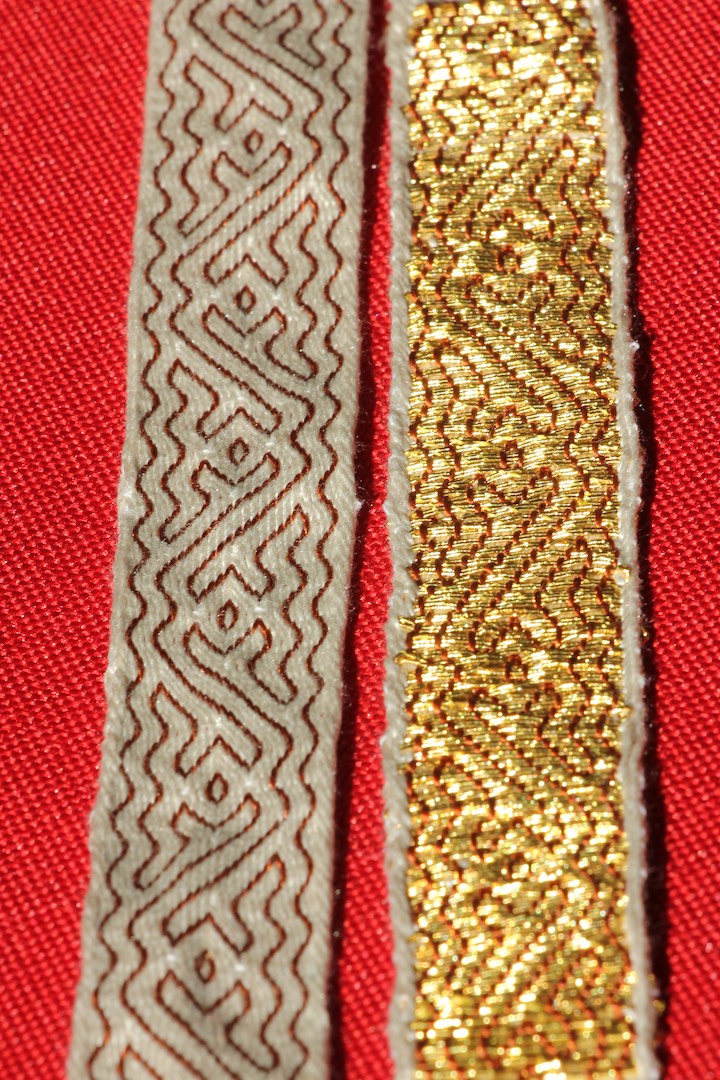
In one place, the original bynd has become so badly worn through centuries of use that hardly any of the brocade remains, and only the base fabric is visible.
The pattern for the reconstruction displayed here was designed many years ago by Fabian Peise. Having had the opportunity to examine the original in the museum in 2014, I consider his reconstruction to be accurate.
For this reproduction, the warp was set up with two colours – three light and one dark thread per heddle. The pattern is a single-insertion pattern with a distinctive, consistent twist rhythm.
When I rewove the border in 2015, the material analysis was not yet available. I therefore used NM-11 silk for the warp and brocaded with gold thread. With a width of 2.6 cm, the reconstruction is very close to the original.
Literatur: Die Textilien im Domschatz zu Halberstadt Band IV, Abegg-Stiftung 2025
Anleitung: Fabian Peise/Silvia Ungerechts
Technik: Einzugsmuster mit individuellem festem Drehrhythmus/Broschieren