
 Im Oktober 2018 hatte ich die Gelegenheit, im Archiv des Museums für Byzantinische Kunst in Berlin einige Textilien zu betrachten.
Eines davon war das Kinderkleid (Inv. Nr. 9935). Es handelt sich um ein Wollgewand aus dem 6./7. Jahrhundert n. Chr., also aus der Sassanidenzeit, das aus Ägypten stammt.
In October 2018, I had the opportunity to examine several textiles in the archive of the Museum of Byzantine Art in Berlin.
One of them was the child's tunic (Inv. No. 9935). It is a woollen garment from Egypt, dating to the 6th/7th century AD, during the Sasanian period.
Die Borte ist in der Online-Datenbank der Sammlung folgendermaßen beschrieben:
„Hals- und Schulteröffnung sowie die Unterkante der Ärmel wurden mit schmalen, hellgrundigen Borten besetzt. Sie sind mit einem Band aus gitterartig unterteilten, violetten Rauten gemustert.“
The band is described in the collection's online database as follows:
“The neck and shoulder openings, as well as the lower edges of the sleeves, were decorated with narrow, light-coloured bands. They are patterned with a band of violet diamonds divided into a lattice-like design.”
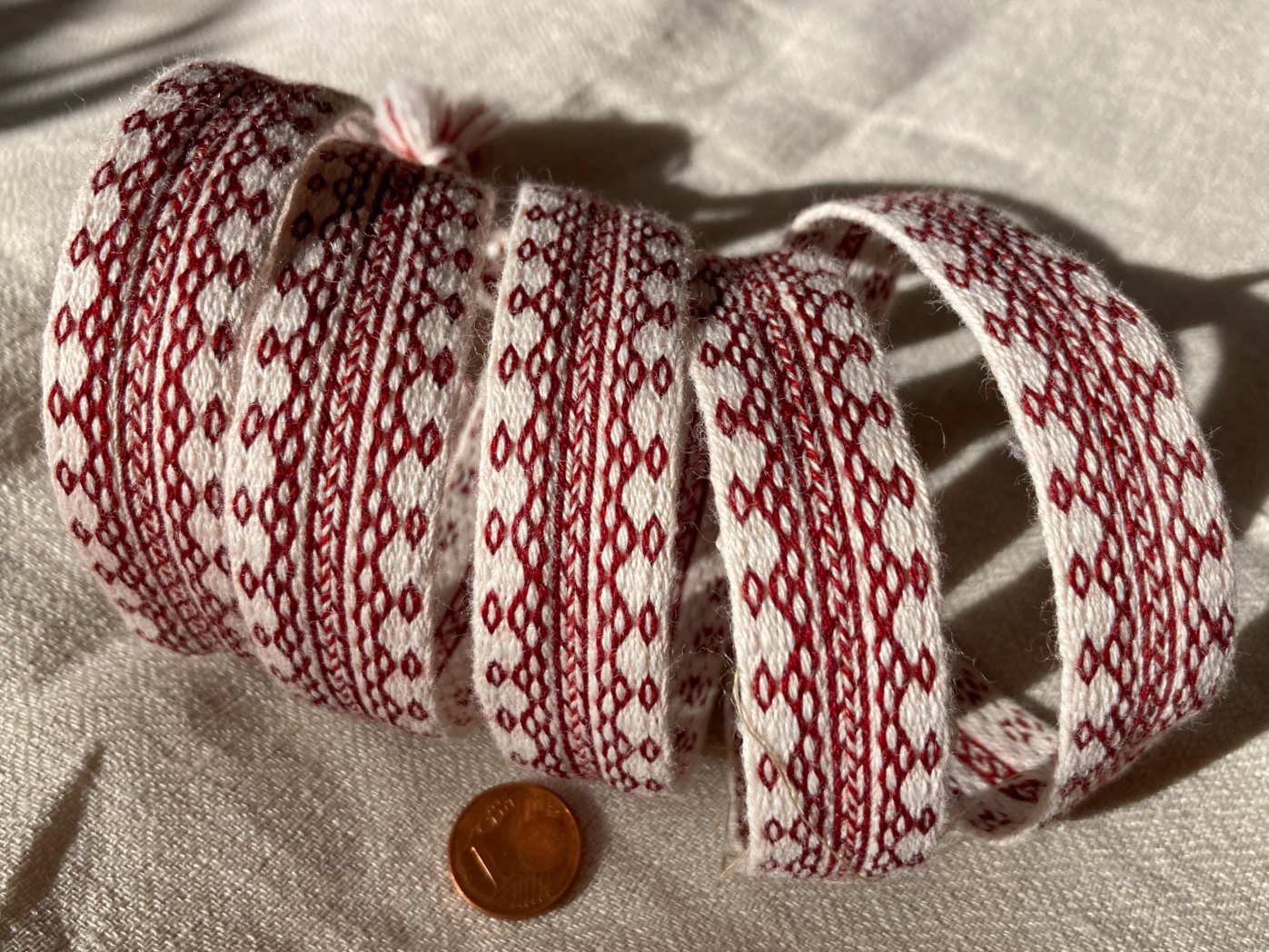
Schon auf den ersten Blick war klar, dass die Borte relativ einfach und schnell zu weben ist. Die Technik lässt sich als einfaches Einzugsmuster mit einem festen, individuellen Drehrhythmus beschreiben.
Besonders interessant war eine Stelle am Handgelenk, die man bei historischen Borten nur selten zu sehen bekommt. Meistens sind lediglich Fragmente erhalten, sodass man nicht erkennen kann, ob und wo sich die Drehrichtung innerhalb eines Musters geändert hat. Hier ist ein solcher Richtungswechsel tatsächlich erhalten. Das sieht dann so aus:
It was clear at first glance that the band is relatively simple and quick to weave. The technique can be described as a simple threading pattern with a fixed, individual turning sequence.
A particularly interesting detail can be seen at the wrist, something rarely found in historical bands. Usually, only fragments of bands survive, so it is impossible to tell whether and where the turning direction changed within a pattern. Here, an actual change of direction has survived. It looks like this:
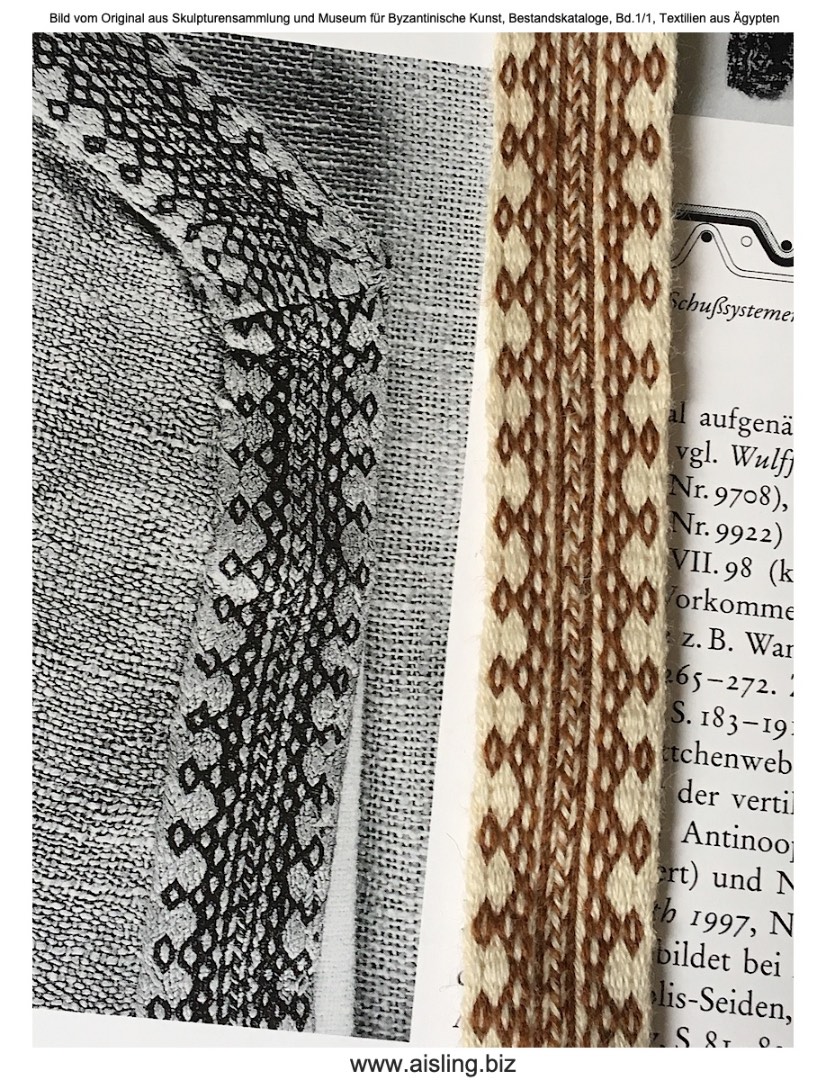
Daten des Originals
Das Band wurde mit 29 Brettchen gewebt, die alle mit vier Fäden bezogen waren. Als Kettmaterial diente eine Kombination aus weißem Leinengarn und rotem Wollgarn. Der Schussfaden ist nicht erkennbar; vermutlich wurde dafür ebenfalls weißes Leinengarn verwendet.
Die Brettchen waren individuell eingezogen: 22 Brettchen mit drei hellen und einem dunklen Faden, vier Brettchen mit vier hellen Fäden, zwei Brettchen mit vier dunklen Fäden und ein Brettchen mit zwei hellen und zwei dunklen Fäden. Dieses eine Brettchen war mit geringfügig dickerem Garn bezogen als die übrigen.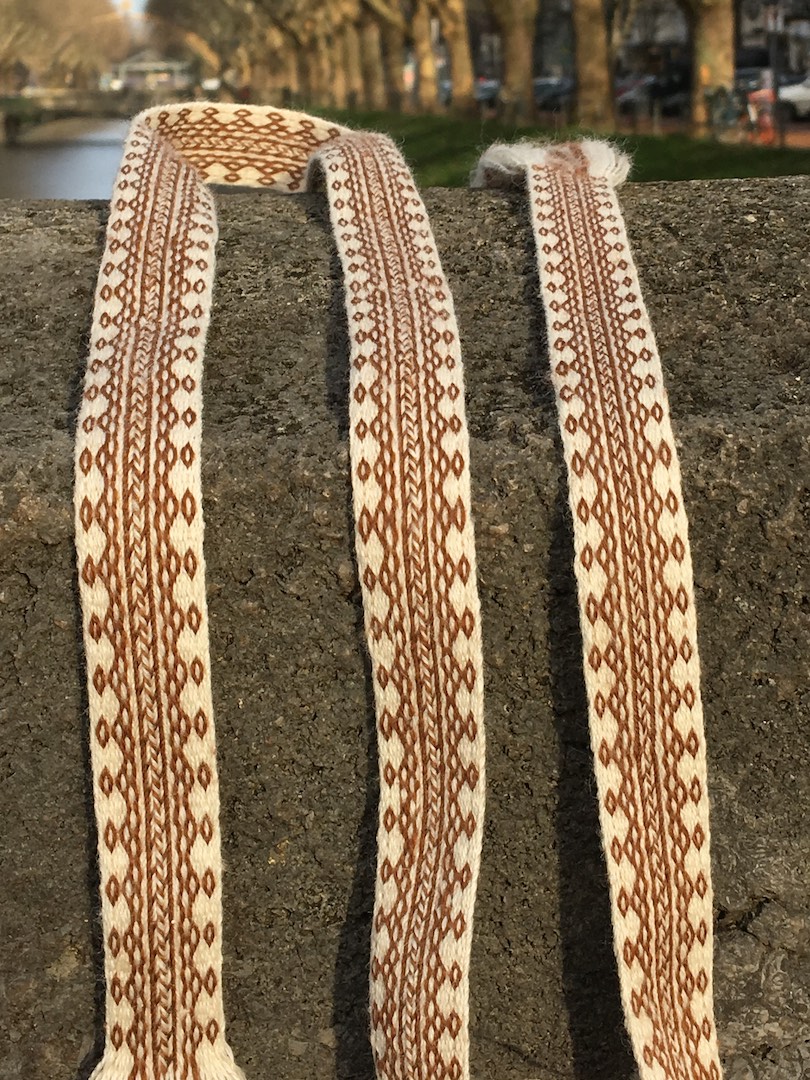 Details of the original
The band was woven with 29 tablets, all threaded with four threads. The warp consisted of a combination of white linen thread and red wool yarn. The weft thread is not visible; it was probably also made of white linen.
The tablets were threaded individually: 22 tablets with three light and one dark thread, four tablets with four light threads, two tablets with four dark threads, and one tablet with two light and two dark threads. This particular tablet was threaded with slightly thicker yarn than the others.
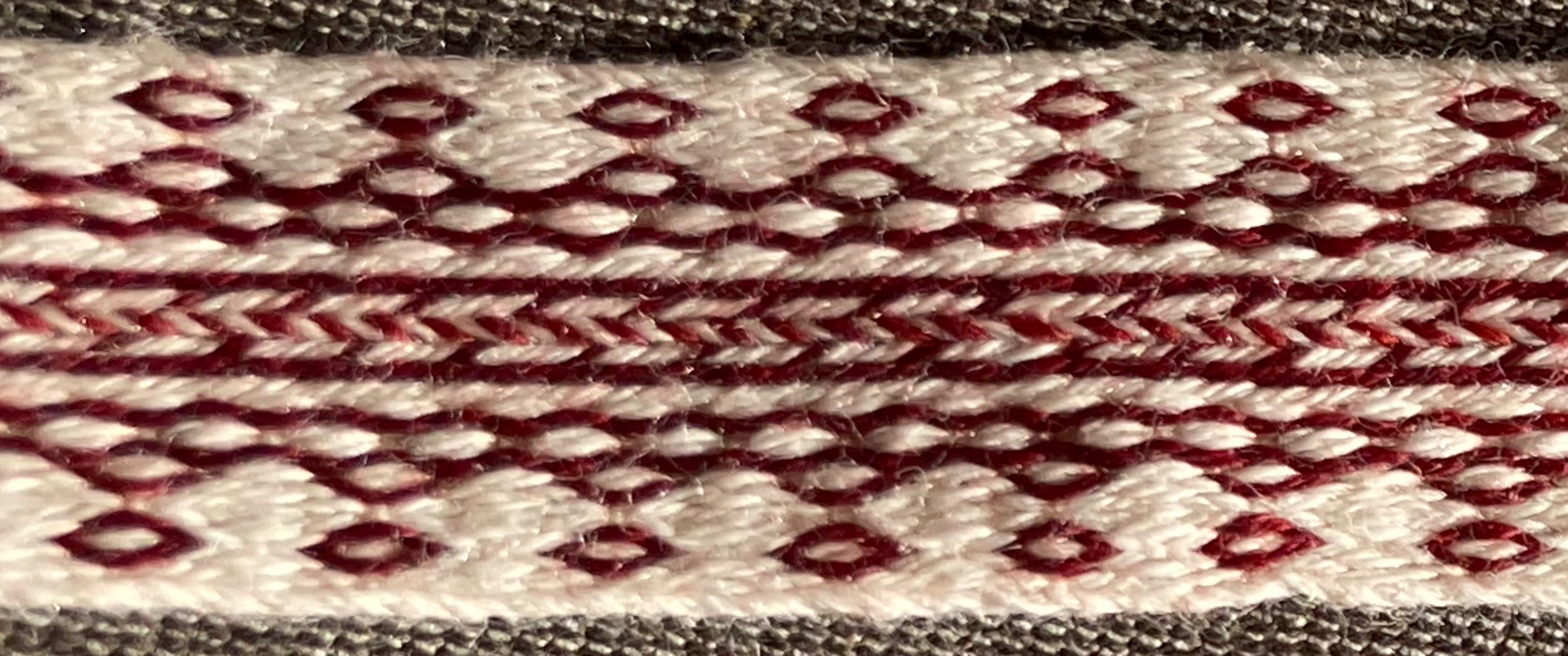
Inzwischen habe ich das Band noch einmal mit feinerem Wollgarn (28/2) gewebt. Für meine Nachwebungen habe ich ausschließlich Wolle verwendet: zunächst weißes und braunes Wollgarn und später weißes und rotes Wollgarn.
I have since woven the band again using finer wool yarn (28/2). For my versions, I used wool only: first white and brown wool, and later white and red wool.
Literatur:
Cäcilia Fluck, Petra Linscheid, Susanne Merz, Skulpturensammlung und Museum für Byzantinische Kunst, Bestandskataloge, Bd.1/1, Textilien aus Ägypten
SMB digital, Stand November 2018
Technik: Einzugsmuster mit individuellem festem Drehrhythmus
Muster: eigener Entwurf veröffentlicht in meinem Buch 'Tablet woven bands from Egypt'