
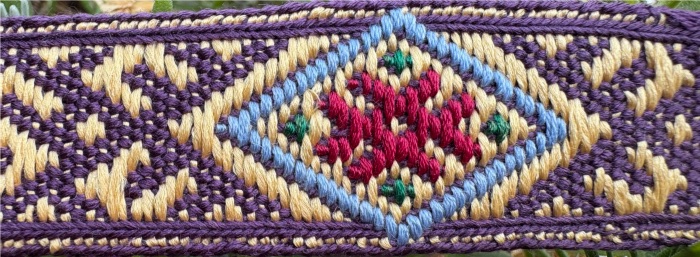
 Dieses Band wurde in Ösmo, Schweden, gefunden und bildet auf der Rückseite eines Messgewandes das aufgenähte Kreuz. Es besteht aus zwei Bortenteilen, die den senkrechten und den waagerechten Kreuzbalken bilden. Eine ähnliche, jedoch gröbere Borte verläuft zusätzlich um den Halsausschnitt. Das Messgewand mit der Inventarnummer 95622_HST befindet sich heute im Statens Historiska Museum in Schweden und wird in die Zeit zwischen 1350 und 1500 datiert.
This band was found in Ösmo, Sweden, and forms the cross sewn onto the back of a chasuble. It consists of two sections of braid, which form the vertical and horizontal arms of the cross. A similar, but coarser, braid also runs around the neckline. The chasuble, with inventory number 95622_HST, is now housed at the Statens Historiska Museum in Sweden and is dated to the period between 1350 and 1500.
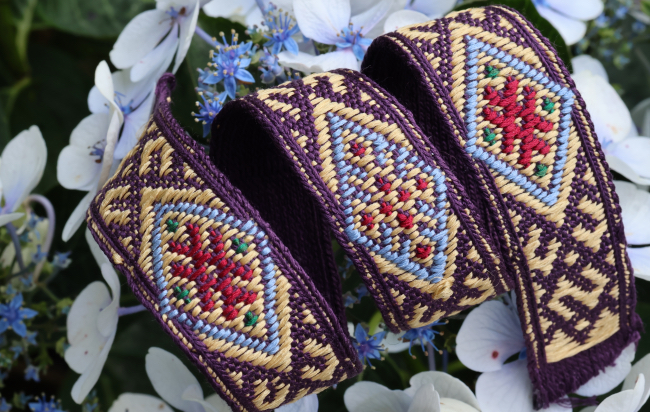
Das Originalband ist 2,5 cm breit. Da die Länge der einzelnen Borten nicht angegeben ist, lässt sie sich nur aus den Maßen des Messgewandes (114 × 86 cm) abschätzen. Demnach dürfte der längere Teil des Kreuzes etwa 100 cm und der kürzere etwa 60 cm messen.
The original band is 2.5 cm wide. As the length of the individual bands is not specified, it can only be estimated from the dimensions of the liturgical vestment (114 × 86 cm). Accordingly, the longer arm of the cross is likely to measure around 100 cm and the shorter arm around 60 cm.
Für die Kette wurden grüne und gelbe Seide verwendet. Broschiert wurde mit doppelt geführtem Goldlahn, dessen Kern S-gesponnen ist, sowie mit doppelt geführter blauer, goldgelber und schwarzer Seide. Das Band wurde mit insgesamt 39 Brettchen gewebt – 27 im Musterbereich sowie je sechs Brettchen an den beiden Rändern. Alle Brettchen waren mit vier Fäden bezogen. Im Musterteil bestanden diese aus je zwei gelben und zwei grünen Fäden, während die Randbrettchen in der Reihenfolge Grün–Gelb–Grün aufgezogen waren. Das Band kombiniert Broschiertechnik mit Köpertechnik, wobei die Brettchen abwechselnd in S- und Z-Stellung aufgezogen wurden.
(Die Angaben zum Aufzug folgen der Beschreibung bei Nancy Spies. Der dort angegebene abwechselnde S-/Z-Aufzug erscheint für die Köpertechnik ungewöhnlich. Da die veröffentlichten Fotos des Originals keine eindeutige Überprüfung zulassen, habe ich die Beschreibung zunächst übernommen.)
Green and yellow silk were used for the weft. The brocade was woven using double-threaded gold thread, the core of which is S-spun, as well as double-threaded blue, golden-yellow and black silk. The ribbon was woven using a total of 39 cards – 27 in the pattern section and six cards on each of the two edges. All cards were covered with four threads. In the patterned section, these consisted of two yellow and two green threads each, whilst the edge heddles were threaded in the order green–yellow–green. The ribbon combines the broche technique with the twill technique, with the heddles threaded alternately in the S and Z positions.
(The details regarding the threading follow the description given by Nancy Spies. The alternating S/Z weave mentioned there seems unusual for the 3/1 broken twill technique. As the published photographs of the original do not allow for a definitive verification, I have adopted the description for the time being.)
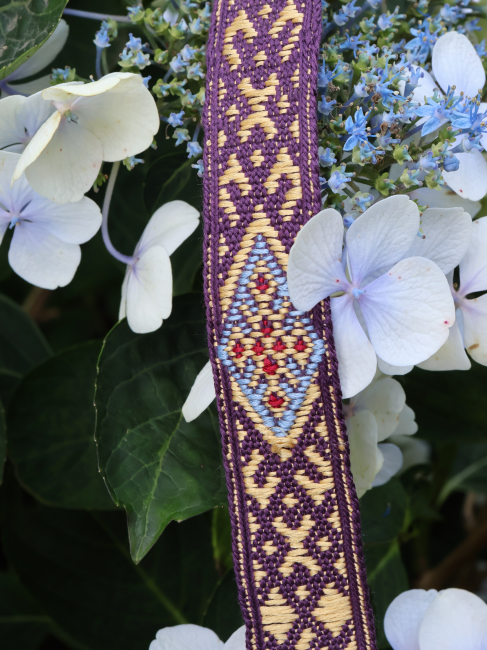
Für das Nachweben habe ich einige Änderungen vorgenommen. Die Brettchen sind einfarbig mit Schappseide aufgezogen, sodass das Band nicht in Köpertechnik, sondern ausschließlich als broschiertes Band gearbeitet ist. Anstelle von Goldlahn verwendete ich gelbe Realseide als Broschierfaden, ergänzt durch blaue, rote und grüne Schappseide. Außerdem hat jeder Rand meiner Nacharbeit vier statt sechs Brettchen. Mit einer Breite von 2,4 cm entspricht das fertige Band dennoch nahezu den Maßen des Originals.
Dieses Band entstand vor 2005. Inzwischen sind zahlreiche hochwertige Abbildungen des Messgewandes online verfügbar. Mit den heutigen Informationen würde ich eine Rekonstruktion anders umsetzen.
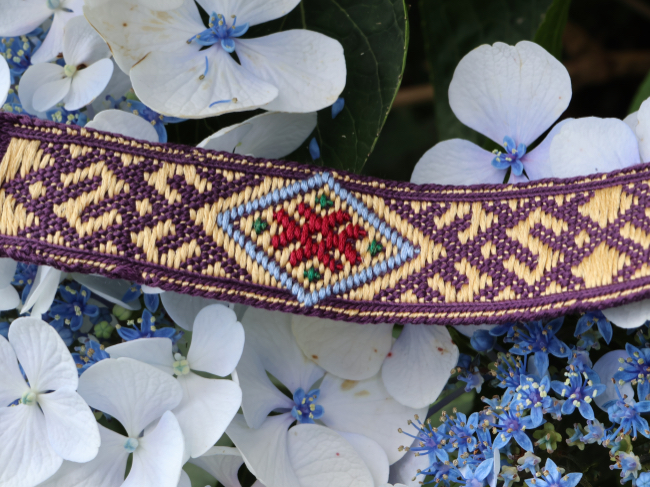
I made a few alterations for the reweaving. The cards are warped with single-colour schapp silk, so that the ribbon is not woven in twill but exclusively as a brocaded band. Instead of gold thread, I used yellow real silk as the brocade thread, supplemented by blue, red and green schapp silk. Furthermore, each selvedge of my reconstruction has four cards instead of six. With a width of 2.4 cm, the finished band nevertheless corresponds almost exactly to the dimensions of the original.
This band was created before 2005. Since then, numerous high-quality images of the chasuble have become available online. With the information available today, I would approach a reconstruction differently.
Literatur:
https://historicaltextiles.org/18-2018-the-weekend-pictures/ stand 16-07.2026
https://samlingar.shm.se/object/A052740A-D7D8-41AA-BB4C-8CBEB5A246FF stand 16.07.2026
Nancy Spies, "Ecclesiastical Pomp & Aristrocatic Circumstance", Maryland 2000
Muster: Nancy Spies
Technik: Broschieren