
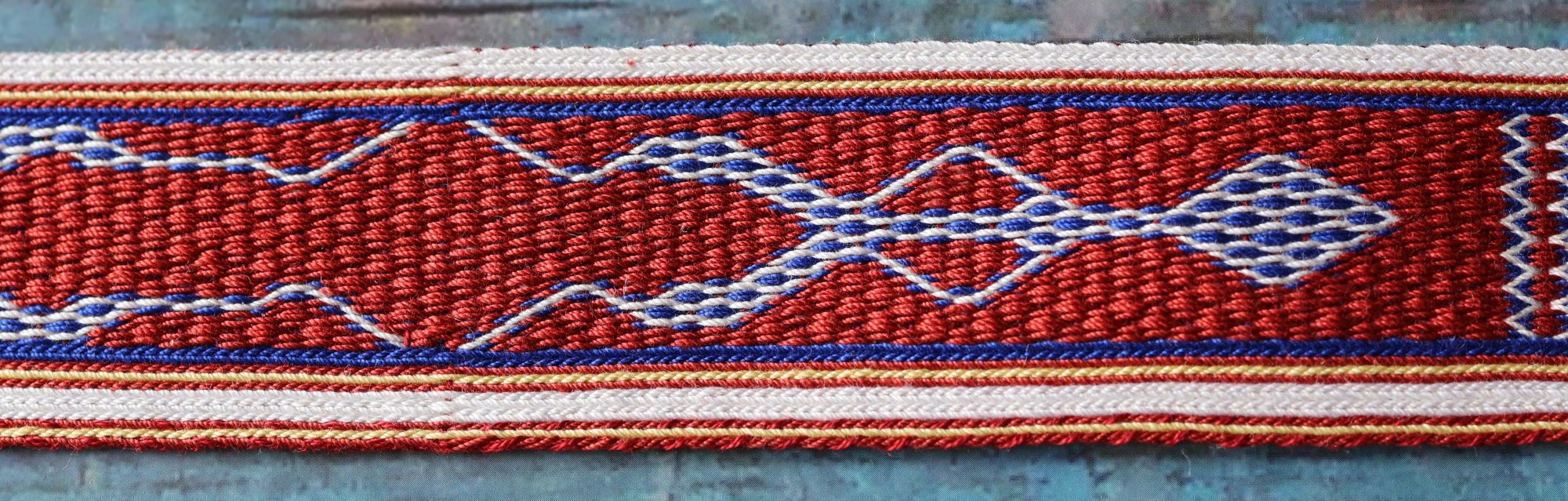
 Besatz für den Sarong eines Tänzers aus Indonesien
Jeder kennt sie, die Sulawesi-Technik, mit der heutzutage so viele Borten gewebt werden. Aber Borten aus Indonesien, die in der Technik gewebt wurden, kennt man kaum.
Dank Keiko Kusakabe und ihren Veröffentlichungen, weiß ich inzwischen mehr darüber.
Dieses Band ist nicht datiert, aber ich vermute, dass er aus der ersten Hälfte des 20. Jhd. stammt. Er wurde in der Region Mamasa von den Mamasa Toraja gewebt und als Besatz für den Sarong eines Tänzers genutzt.
Everyone is familiar with the Sulawesi technique, which is used to weave so many braids nowadays. But braids from Indonesia woven using this technique are hardly known.
Thanks to Keiko Kusakabe and her publications, I now know more about them.
This ribbon is undated, but I suspect it dates from the first half of the 20th century. It was woven in the Mamasa region by the Mamasa Toraja and used as trim for a dancer's sarong.
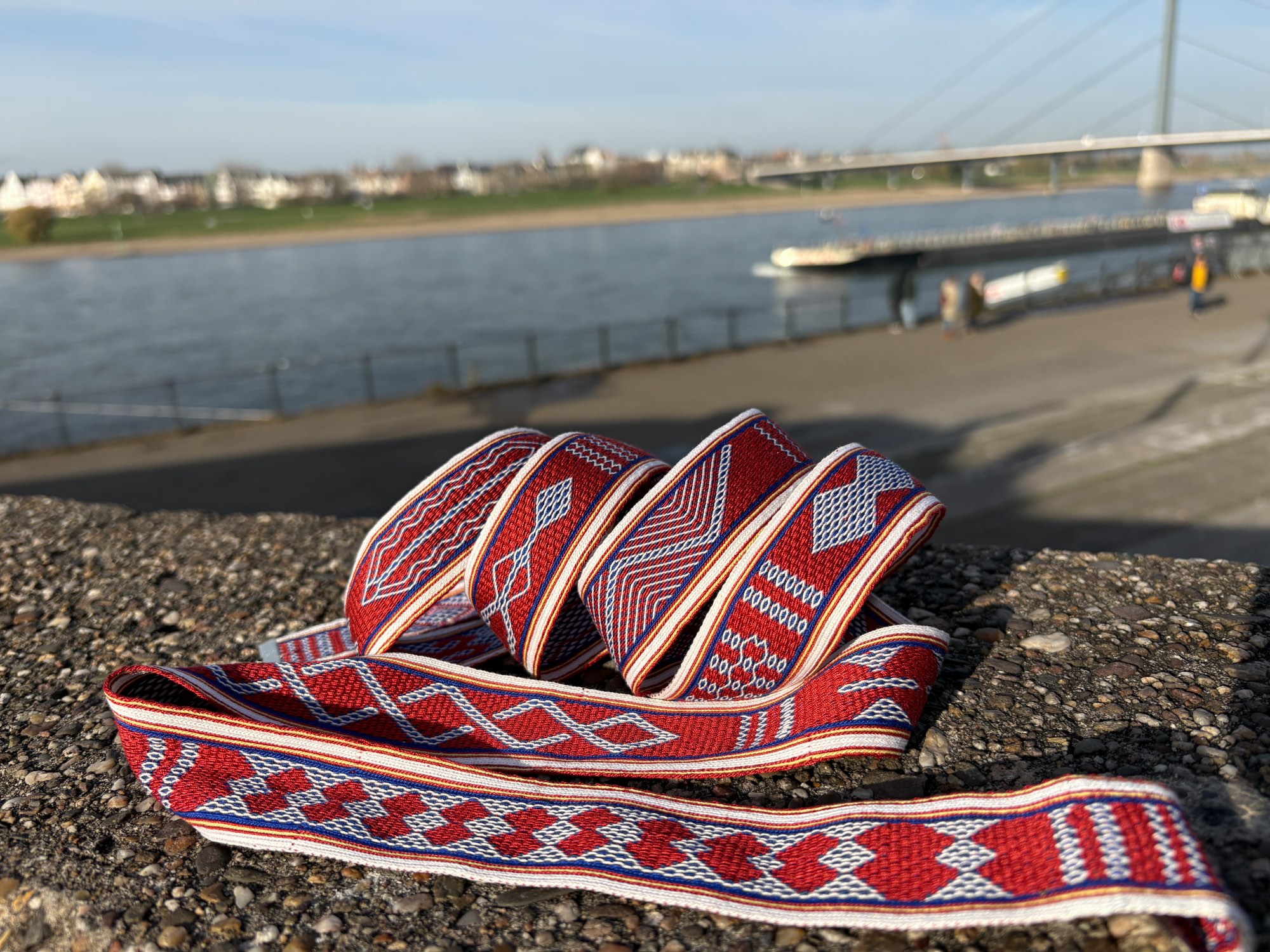
Das Band weist einen vom üblichen Sulawesi-Typ abweichenden Farbverlauf auf: Statt der klassischen Abfolge Farbe 1 – Farbe 2 – Farbe 3 – Farbe 2 folgt es dem Schema Farbe 1 – Farbe 2 – Farbe 3 – Farbe 3. Farbe 1 und Farbe 2 werden wie eine Farbe beim Doubleface behandelt. Es ist aber ein Farbablauf, der bei den Mamasa öfter verwendet wird.
The ribbon has a colour gradient that differs from the usual Sulawesi type: instead of the classic sequence colour 1 – colour 2 – colour 3 – colour 2, it follows the pattern colour 1 – colour 2 – colour 3 – colour 3. Colour 1 and colour 2 are treated like one colour in a double-faced ribbon. This is a colour sequence that is often used in Mamasa.
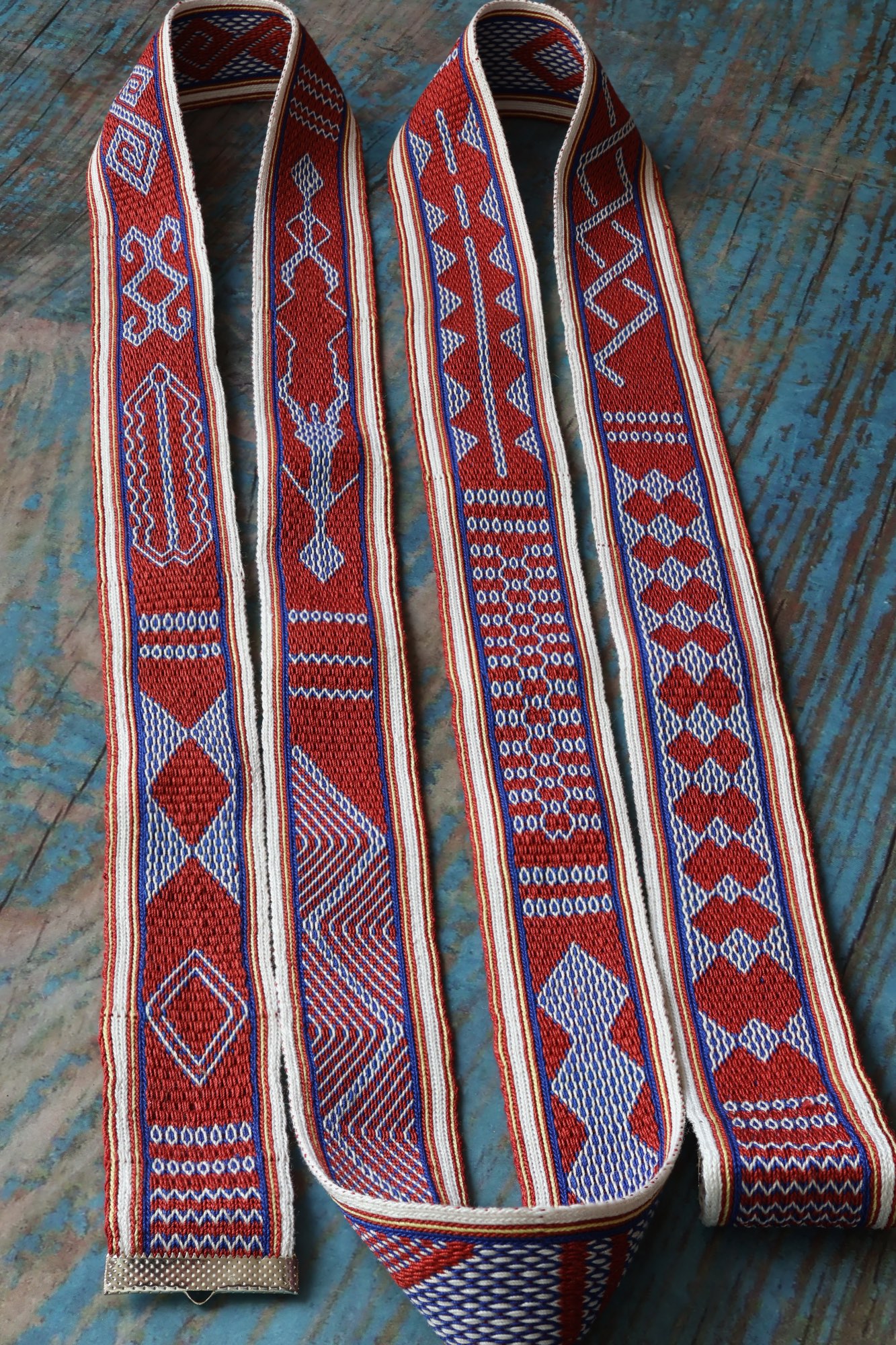
Das Gewebe wurde mit 54 Brettchen hergestellt, davon 28 Musterbrettchen, die in der Farbreihenfolge Weiß – Blau – Rot – Rot aufgekettet wurden; weiß bildet die Musterfarbe. Man hat hier Baumwolle zum Weben verwendet. Das Band ist 3 cm breit und 155,5 cm lang. Die Dekoration besteht aus zahlreichen geometrischen Motiven sowie zwei figürlichen Darstellungen, die als Tänzer interpretiert werden können.
Ich habe statt mit 54 Brettchen nur mit 50 Brettchen gewebt, weil ich nicht genug rotes Garn hatte, damit ist das Band 3,2 cm breit geworden. Bei einer Länge von 1,80 m habe ich es nicht geschafft, alle Motive komplett zu weben, ich musste es einkürzen.
The fabric was made using 54 tablets, 28 of which were pattern tablets that were warped in the colour sequence white – blue – red – red; white is the pattern colour. Cotton was used for weaving. The ribbon is 3 cm wide and 155.5 cm long. The decoration consists of numerous geometric motifs and two figurative representations that can be interpreted as dancers.
Instead of 54 tablets, I only wove with 50 tablets because I didn't have enough red yarn, so the ribbon ended up being 3.2 cm wide. With a length of 1.80 m, I didn't manage to weave all the motifs completely, so I had to shorten it.
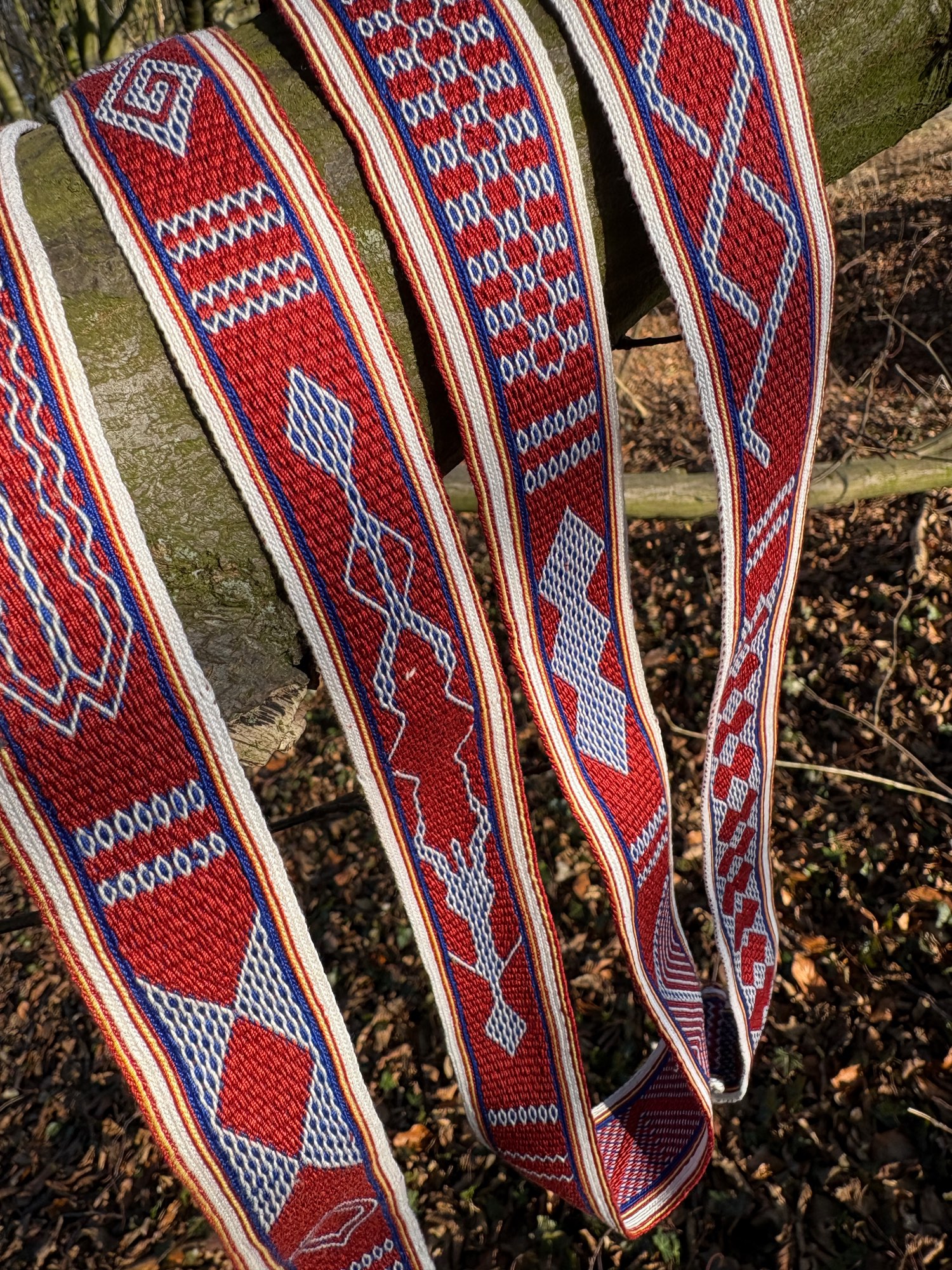
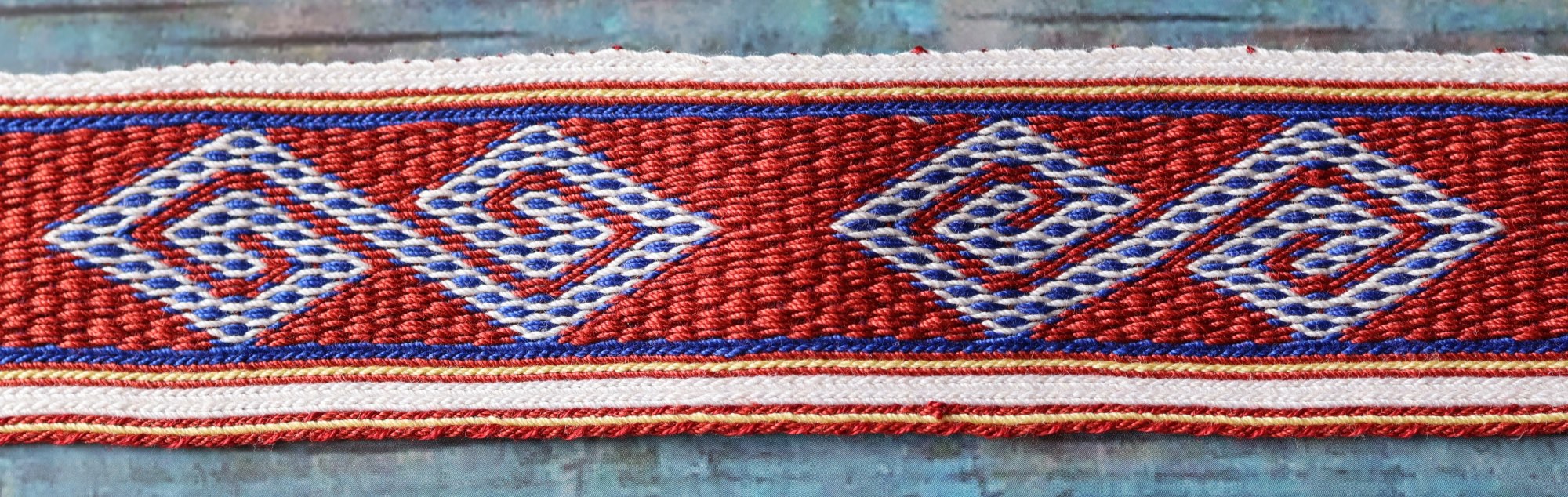
Ich habe ein Motiv auf Twisted Threads veröffentlicht. I published one motif on Twisted Threads
Literatur: The Keiko Kusakabe Collection, Textiles from Sulawesi in Indonsia, Fukuoka Art Museum, 2006
A techno-ethnography of Toraja-Mamasa tablet weavings from Sulawesi, Indonesia. Part 1: Prior studies, current findings, and geographic distributions
Technik: Sulawesi
Anleitung: Eigener Entwurf